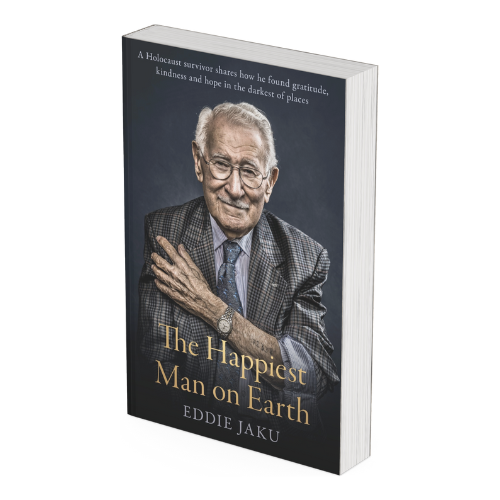
The Happiest Man on Earth
by Eddie Jaku
Eddie Jaku was born Abraham Jakubowicz in 1920 in Leipzig, Germany, with a loving Jewish parentage. As a young man, he saw for himself Nazi Germany’s rise, the loss of his home and the terrible atrocities of concentration camps, like Auschwitz. In Australia, Eddie rebuilt his life after the war, despite the horrors of war and loss — a loving family and a successful career as an engineer. He spent his latter years telling his story to the vast world, telling thousands about resilience, kindness, and the spirit of gratitude. Eddie died in 2021 at the age of 101, but he did leave a legacy of hope.
In this memoir, we follow an extraordinary life- Journey of Eddie Jaku, a Holocaust survivor who lived in spite of the deepest elements of inhumanity, and whose life was lived to a kind of joy, a hope, and of compassion.
Eddie’s early life in Germany was joyful and stable, until Nazi persecution shattered it all. He was expelled from school because he was Jewish and sent to a boarding school under false identity. Eddie was arrested on Kristallnacht day in 1938 and beaten and sent away to the concentration camp at Buchenwald. What ensued was years of imprisonment, torture, starvation, slave work and in a number of camps, including Auschwitz, where he lost friends and family and was afraid of death.
Eddie survived — often thanks to his technical abilities, ingenuity and the help of other prisoners. After the war he was re-entered the world in ruins, without a family there. Settling from hate and bitterness, Eddie devoted the remainder of his life to kindness and gratitude. From nothing he self-construed, ultimately emigrating to Australia, marrying and having a family and building a family.
His own philosophy of life is apparent even in the book’s title: Happiness doesn’t depend on what life gives you but rather on what you choose to do with it. Even when you suffer the most catastrophic losses, he insists that there are still moments or actions filled with joy– moments which are not all that distressing at all and people like him. No one takes optimism and decides they like it so much it’s like living in the service of a cause. This book is full of humility. It’s a story that unapologetically rejects all excuses we give for not living fully. Eddie Jaku lived hell on earth, but he kept resisting the impulse to harden, to be bitter, to turn cynical. That’s not about being “positive” in the cute, Instagram-inspirational sense. It’s about being deliberate. Deciding to live in a way that makes every challenge life throws at you worthwhile.
What has impacted me the most is Eddie’s understanding of kindness. In the camps, kindness might be the difference between life and death. The kindness here is not a question of survival, but it can definitely change how someone’s day or life is moving.
He also says with brutal honesty that survival isn’t synonymous with eliminating suffering. Trauma leaves scars. He does not attempt to whitewash the darkness of what took place or claim that forgiveness is an easy task. But he says he cannot be defined by hatred. It’s a day-to-day commitment that requires courage; everyone makes them. I realize how much we throw ourselves, in our own thinking of all the petty irritants and contrived dramatics. Eddie’s life is a demonstration that we cannot afford to be ungrateful or inhuman. They are the basis of resilience. You don’t have to survive a concentration camp to take that lesson seriously.
This isn’t merely a Holocaust memoir. It’s a manual of living with dignity and purpose. It’s a reminder that the measure of life is not what happens to you, but what you give.
I urge my clients and colleagues to implement the principles of “The Happiest Man on Earth”.
- Gratitude is a daily practice – Don’t wait for life to be perfect before you start being thankful.
- Kindness is powerful – Even in the worst environments, a small act of care can change someone’s path.
- Choose your response – You can’t control all events, but you can control how you react.
- Resilience comes from purpose – Have something bigger than yourself to live for.
- Don’t waste time on hate – It drains your energy and stifles healing.
- Relationships are survival aids – Form bonds of truth, without which nothing else matters.
- Find meaning in the little things – Even a little moment is worth savoring.
- Be honest, don’t try to sugarcoat – Acknowledge the harsh living conditions honestly while not letting them define who you are.
- Healing is an ongoing process – There is no such thing as a just “finished” recovery.
- Tell your story — Speaking out helps you and others, it ensures wisdom never dies.In summary.
Eddie Jaku’s life proves that even in humanity’s bleakest hours, hope and kindness endure. His story implores us to live with courage, gratitude and compassion every day. It’s not a matter of rejecting pain — it’s a matter of choosing joy in spite of it.
The Happiest Man on Earth
by Eddie Jaku
Eddie Jaku was born Abraham Jakubowicz in 1920 in Leipzig, Germany, with a loving Jewish parentage. As a young man, he saw for himself Nazi Germany’s rise, the loss of his home and the terrible atrocities of concentration camps, like Auschwitz. In Australia, Eddie rebuilt his life after the war, despite the horrors of war and loss — a loving family and a successful career as an engineer. He spent his latter years telling his story to the vast world, telling thousands about resilience, kindness, and the spirit of gratitude. Eddie died in 2021 at the age of 101, but he did leave a legacy of hope.
In this memoir, we follow an extraordinary life- Journey of Eddie Jaku, a Holocaust survivor who lived in spite of the deepest elements of inhumanity, and whose life was lived to a kind of joy, a hope, and of compassion.
Eddie’s early life in Germany was joyful and stable, until Nazi persecution shattered it all. He was expelled from school because he was Jewish and sent to a boarding school under false identity. Eddie was arrested on Kristallnacht day in 1938 and beaten and sent away to the concentration camp at Buchenwald. What ensued was years of imprisonment, torture, starvation, slave work and in a number of camps, including Auschwitz, where he lost friends and family and was afraid of death.
Eddie survived — often thanks to his technical abilities, ingenuity and the help of other prisoners. After the war he was re-entered the world in ruins, without a family there. Settling from hate and bitterness, Eddie devoted the remainder of his life to kindness and gratitude. From nothing he self-construed, ultimately emigrating to Australia, marrying and having a family and building a family.
His own philosophy of life is apparent even in the book’s title: Happiness doesn’t depend on what life gives you but rather on what you choose to do with it. Even when you suffer the most catastrophic losses, he insists that there are still moments or actions filled with joy– moments which are not all that distressing at all and people like him. No one takes optimism and decides they like it so much it’s like living in the service of a cause. This book is full of humility. It’s a story that unapologetically rejects all excuses we give for not living fully. Eddie Jaku lived hell on earth, but he kept resisting the impulse to harden, to be bitter, to turn cynical. That’s not about being “positive” in the cute, Instagram-inspirational sense. It’s about being deliberate. Deciding to live in a way that makes every challenge life throws at you worthwhile.
What has impacted me the most is Eddie’s understanding of kindness. In the camps, kindness might be the difference between life and death. The kindness here is not a question of survival, but it can definitely change how someone’s day or life is moving.
He also says with brutal honesty that survival isn’t synonymous with eliminating suffering. Trauma leaves scars. He does not attempt to whitewash the darkness of what took place or claim that forgiveness is an easy task. But he says he cannot be defined by hatred. It’s a day-to-day commitment that requires courage; everyone makes them. I realize how much we throw ourselves, in our own thinking of all the petty irritants and contrived dramatics. Eddie’s life is a demonstration that we cannot afford to be ungrateful or inhuman. They are the basis of resilience. You don’t have to survive a concentration camp to take that lesson seriously.
This isn’t merely a Holocaust memoir. It’s a manual of living with dignity and purpose. It’s a reminder that the measure of life is not what happens to you, but what you give.
I urge my clients and colleagues to implement the principles of “The Happiest Man on Earth”.
- Gratitude is a daily practice – Don’t wait for life to be perfect before you start being thankful.
- Kindness is powerful – Even in the worst environments, a small act of care can change someone’s path.
- Choose your response – You can’t control all events, but you can control how you react.
- Resilience comes from purpose – Have something bigger than yourself to live for.
- Don’t waste time on hate – It drains your energy and stifles healing.
- Relationships are survival aids – Form bonds of truth, without which nothing else matters.
- Find meaning in the little things – Even a little moment is worth savoring.
- Be honest, don’t try to sugarcoat – Acknowledge the harsh living conditions honestly while not letting them define who you are.
- Healing is an ongoing process – There is no such thing as a just “finished” recovery.
- Tell your story — Speaking out helps you and others, it ensures wisdom never dies.In summary.
Eddie Jaku’s life proves that even in humanity’s bleakest hours, hope and kindness endure. His story implores us to live with courage, gratitude and compassion every day. It’s not a matter of rejecting pain — it’s a matter of choosing joy in spite of it.
“The greatest glory in living lies not in never falling, but in rising every time we fall.”
Recent Thoughts
Performance Lab Environment for Mental Clarity and Focus
High performers are seldom incompetent. They struggle with carryover. Carryover of stress. Carryover of emotion. Carryover of intensity from one room to another.

High Performance Without Burnout
When work is in the high performers’ way, it is very addictive. They are quick, decisive, disciplined, competitive and outcome-oriented. They raise standards.