
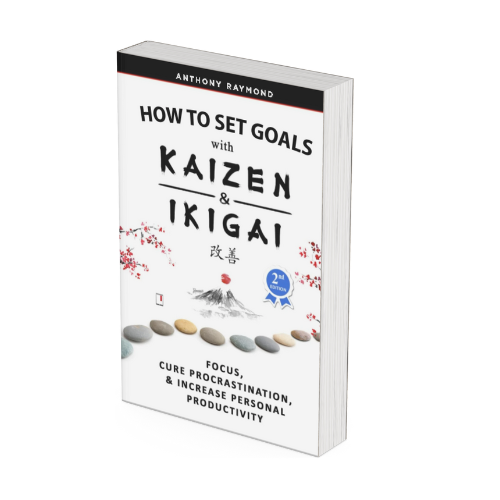
How to Set Goals with Kaizen & Ikigai
by Anthony Raymond
Anthony Raymond is an independent author specializing in productivity and self-improvement. His focus is on synthesizing Eastern philosophies and practical methods of living today. Many of his best-known titles, especially, focus on continuous improvement through Kaizen & Ikigai and finding your vocation. Raymond’s writing is marked by its pragmatic manner and clear presentation, enabling a wide audience to comprehend complex concepts. His writing attracted praise for its ability to incite success, for its emphasis in motivating readers to live their lives purposefully, then for making progress bit by bit, making it to success, both personal and professional.
Ikigai:
He defined Ikigai, a Japanese term that translates to “reason for being,” which means an action or philosophy for which one does or does not know something. It is the confluence of what you like, what you can do, the stuff the world wants, and a price to be paid to get that done. Raymond stresses that realizing who you are at Ikigai involves looking inside yourself and matching what you do to who you have always been and desire to become every single day.
Kaizen:
Raymond sets out the basic principles of Kaizen, which include a focused and step-by-step process of dividing up objectives into manageable tasks and a continuous evaluation of success and failure.
Combine Kaizen and Ikigai:
And then the book explores the deep personal and professional progress one can achieve through the fusion of the two philosophies. Kaizen—the practical tools for life—and Ikigai help people achieve a whole life with a sense of purpose. Raymond provides readers with how-tos to help them start incorporating Kaizen and Ikigai into their lives. They are about reviewing one’s progress regularly, maintaining a mindset of betterment and working towards very achievable goals.
Anthony Raymond’s “Ikigai and Kaizen” was such an eye-opening journey as it offers useful techniques and some weighty thoughts – resonant reflections – which parallel the concepts I apply/pursue in my work and practice. My holistic approach to personal development and therapy matches perfectly with this book’s mix of Eastern philosophies and practical applications.
Ikigai is one of the key ideas in the book. Understanding and realizing my Ikigai was therefore vital in my pursuit of job relevance as well as personal identity through a balance of work and home. For Ikigai, a complete lifestyle in which fulfilment of personal happiness and ambition co-exist in harmony results. This strikes a chord with me, and resonates deeply in practice with my work as a psychotherapist in what it represents as providing mental health counseling at the centre of my practice which is to help my clients find their real calling and to help guide them through everyday life and make sure their work-life relationship is rooted in their essential values.
The philosophy of Kaizen of continuous improvement by incremental action is especially resonant. I always see clients and team members get overwhelmed in my jobs and my enterprises. Kaizen sets up a system of breaking down these goals into feasible tasks. In short, the Kaizen approach provides one way of dissecting those objectives into manageable tasks that people can realistically undertake in order to help them achieve their goals and move on. This concept is consistent with cognitive-behavioural approaches characterized by a gradual but steady movement towards progress and effort over time.
Ikigai blended with Kaizen is a holistic philosophy for both personal and professional growth. Through purposeful living along with continuous improvement, individuals can create an optimal lifestyle. I feel a combination of this perspective (holistic living) is necessary when doing therapy, and I do it from a therapeutic perspective of seeking meaning through goals and refining skills and habits.
Practical Applications in Therapy
Goal setting: By motivating clients to set realistic and achievable goals in line with their Ikigai, this means you’ll stay motivated and focus on the big picture.
Reflection: Regular, reflective sessions (Hansei) should be included to follow up on progress toward evaluation and focus the change in an effort to recognize improvement opportunities. This allows the clients to maintain focus and change strategies accordingly.
Progressive Action: This encourages Kaizen—gradualize the movement of incrementally modifying your practice to make changes to build momentum. It gets rid of that overwhelm which often accompanies big life changes.
Holistic Well-being: Emphasizing the necessity of balancing professional achievements and personal pleasure, and ensuring the customers lead a well-rounded existence.
Personal Insights and Growth
“Ikigai and Kaizen” has offered valuable tools in my professional practice and led to personal growth. Discovering my Ikigai is an enriching process through the journey, helping me get in tune with passions and life values that have been built in to me. This alignment adds an extra layer of sense of purpose and fulfilment to a person’s life which makes them feel a certain amount of satisfaction throughout the time.
The Kaizen approach reiterates that patience and perseverance don’t cease to be important. So far I have been able to achieve a lot of good progress in different areas of my life by concentrating on the small, incremental improvement. I have been able to rise above them and not falter from my long term goals that would likely stem from this principle.
In conclusion.
Anthony Raymond’s book Ikigai and Kaizen provides deep understanding and concrete tips for achieving personal happiness and success in your profession. By putting these two potent philosophies hand in hand, it offers an overall framework for life well-rounded. As a psychotherapist and mentor, my thoughts on Raymond’s ideas are invaluable for guiding people toward a holistic level of wellbeing and continuous improvement. He sees all of those points and has made a great deal of sense to me. For people who would like to enrich their life, both personally and in their profession, by applying intentional living and taking baby steps then this is a novel of the time.
How to Set Goals with Kaizen & Ikigai
by Anthony Raymond
Anthony Raymond is an independent author specializing in productivity and self-improvement. His focus is on synthesizing Eastern philosophies and practical methods of living today. Many of his best-known titles, especially, focus on continuous improvement through Kaizen & Ikigai and finding your vocation. Raymond’s writing is marked by its pragmatic manner and clear presentation, enabling a wide audience to comprehend complex concepts. His writing attracted praise for its ability to incite success, for its emphasis in motivating readers to live their lives purposefully, then for making progress bit by bit, making it to success, both personal and professional.
Ikigai:
He defined Ikigai, a Japanese term that translates to “reason for being,” which means an action or philosophy for which one does or does not know something. It is the confluence of what you like, what you can do, the stuff the world wants, and a price to be paid to get that done. Raymond stresses that realizing who you are at Ikigai involves looking inside yourself and matching what you do to who you have always been and desire to become every single day.
Kaizen:
Raymond sets out the basic principles of Kaizen, which include a focused and step-by-step process of dividing up objectives into manageable tasks and a continuous evaluation of success and failure.
Combine Kaizen and Ikigai:
And then the book explores the deep personal and professional progress one can achieve through the fusion of the two philosophies. Kaizen—the practical tools for life—and Ikigai help people achieve a whole life with a sense of purpose. Raymond provides readers with how-tos to help them start incorporating Kaizen and Ikigai into their lives. They are about reviewing one’s progress regularly, maintaining a mindset of betterment and working towards very achievable goals.
Anthony Raymond’s “Ikigai and Kaizen” was such an eye-opening journey as it offers useful techniques and some weighty thoughts – resonant reflections – which parallel the concepts I apply/pursue in my work and practice. My holistic approach to personal development and therapy matches perfectly with this book’s mix of Eastern philosophies and practical applications.
Ikigai is one of the key ideas in the book. Understanding and realizing my Ikigai was therefore vital in my pursuit of job relevance as well as personal identity through a balance of work and home. For Ikigai, a complete lifestyle in which fulfilment of personal happiness and ambition co-exist in harmony results. This strikes a chord with me, and resonates deeply in practice with my work as a psychotherapist in what it represents as providing mental health counseling at the centre of my practice which is to help my clients find their real calling and to help guide them through everyday life and make sure their work-life relationship is rooted in their essential values.
The philosophy of Kaizen of continuous improvement by incremental action is especially resonant. I always see clients and team members get overwhelmed in my jobs and my enterprises. Kaizen sets up a system of breaking down these goals into feasible tasks. In short, the Kaizen approach provides one way of dissecting those objectives into manageable tasks that people can realistically undertake in order to help them achieve their goals and move on. This concept is consistent with cognitive-behavioural approaches characterized by a gradual but steady movement towards progress and effort over time.
Ikigai blended with Kaizen is a holistic philosophy for both personal and professional growth. Through purposeful living along with continuous improvement, individuals can create an optimal lifestyle. I feel a combination of this perspective (holistic living) is necessary when doing therapy, and I do it from a therapeutic perspective of seeking meaning through goals and refining skills and habits.
Practical Applications in Therapy
Goal setting: By motivating clients to set realistic and achievable goals in line with their Ikigai, this means you’ll stay motivated and focus on the big picture.
Reflection: Regular, reflective sessions (Hansei) should be included to follow up on progress toward evaluation and focus the change in an effort to recognize improvement opportunities. This allows the clients to maintain focus and change strategies accordingly.
Progressive Action: This encourages Kaizen—gradualize the movement of incrementally modifying your practice to make changes to build momentum. It gets rid of that overwhelm which often accompanies big life changes.
Holistic Well-being: Emphasizing the necessity of balancing professional achievements and personal pleasure, and ensuring the customers lead a well-rounded existence.
Personal Insights and Growth
“Ikigai and Kaizen” has offered valuable tools in my professional practice and led to personal growth. Discovering my Ikigai is an enriching process through the journey, helping me get in tune with passions and life values that have been built in to me. This alignment adds an extra layer of sense of purpose and fulfilment to a person’s life which makes them feel a certain amount of satisfaction throughout the time.
The Kaizen approach reiterates that patience and perseverance don’t cease to be important. So far I have been able to achieve a lot of good progress in different areas of my life by concentrating on the small, incremental improvement. I have been able to rise above them and not falter from my long term goals that would likely stem from this principle.
In conclusion.
Anthony Raymond’s book Ikigai and Kaizen provides deep understanding and concrete tips for achieving personal happiness and success in your profession. By putting these two potent philosophies hand in hand, it offers an overall framework for life well-rounded. As a psychotherapist and mentor, my thoughts on Raymond’s ideas are invaluable for guiding people toward a holistic level of wellbeing and continuous improvement. He sees all of those points and has made a great deal of sense to me. For people who would like to enrich their life, both personally and in their profession, by applying intentional living and taking baby steps then this is a novel of the time.
“True healing occurs when I accept the circumstances of my life and forgive myself.”
Recent Thoughts

Performance Lab Environment for Mental Clarity and Focus
High performers are seldom incompetent. They struggle with carryover. Carryover of stress. Carryover of emotion. Carryover of intensity from one room to another.

High Performance Without Burnout
When work is in the high performers’ way, it is very addictive. They are quick, decisive, disciplined, competitive and outcome-oriented. They raise standards.