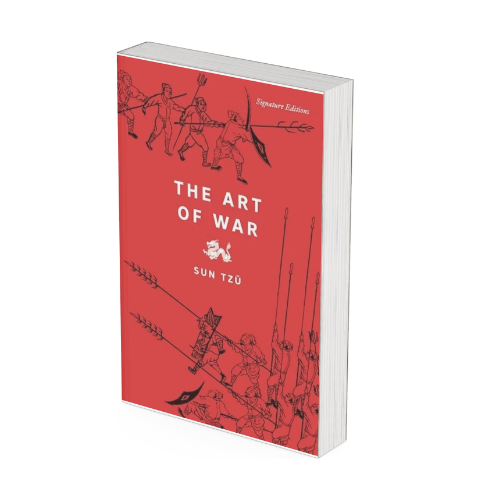
The Art of War
by Sun Tzu
In more recent times researchers have been debating the fact that Sun Tzu – the ancient Chinese strategist – wrote The Art of War. Although much of his life is shrouded in mystery, the records reveal that he lived in the Spring and Autumn period. His perennial military treatise has shaped and influenced thinking in Eastern and Western worlds about leadership, strategy and warfare. The enduring significance of Sun Tzu’s wisdom in business, politics, or self-betterment has underscored the immense force of his ideas.
In 13 chapters, the book is a full-length manual for military strategy and tactics. Preparation planning is carefully crafted, well-prepared to engage in armed conflict that entails an enormous amount of information on the strengths and weaknesses. Successful war is the use of resources to not be drawn out, not dragging on wars that break morale and weaken economies. Flexibility, position, deception, morale, terrain, and intelligence are the crux of Sun Tzu’s strategic thinking.
For anyone who values both leadership, strategy, and studying human behaviour, there is a need to read The Art of War. As a psychotherapist, Sun Tzu’s teachings have not only fit into a military context. Alludes his ideas toward discipline, foresight, and adaptability is extremely valuable from a professional viewpoint and insight-oriented perspective. And as a result of that book, my understanding of growth along with management roles expanded and evolved.
As Sun Tzu observed, preparation is critical to success in many environments. This applies well in therapy, as preparation shapes how therapeutic interventions are created. When the approaches are customised to a client’s individual history and psychological profile, outcomes are greatly improved. A skilled therapist can facilitate sustained, significant behaviour and emotional change.
Sun Tzu taught that we need to be adaptable – so, too, do therapists. Strict approaches ignore many of the nuances of human behaviour and changing relational processes. Flexibility enables practitioners to better respond to changing client needs and the unforeseen events that come with them as they occur. So being flexible allows us to enter into the unknown with resilience, confidence and hence we also find this makes us much more effective in therapy too.
In accordance with Sun Tzu, identifying the nature of an opponent is crucial. Deep understanding of a client’s motivations and thoughts in therapy facilitates progress and significance. While lying is, of course, unethical behavior — as it was in the psych-therapy sessions — strategic insight and perception is crucial. In fact, knowing where others come from increases empathy, communication, and better resolution of interpersonal conflicts.
Leadership is the core of unity, purpose and morale — concepts that Sun Tzu has a surprisingly lucid explanation of. In my role as a leader, I strive towards positivity and role modeling in resilience through each of my followers. A few people say that you direct the people you lead to help them reach their maximum potential through ethical behavior. Good leaders not only deliver results; they develop mutual respect and psychological safety.
I Encourage.
Act Now: Work hard, plan and prepare for both your personal aspirations and your career goals — make plans, plan and you will do exactly that.
Adaptability: Adapt quickly to new challenges and embrace new ideas with flexibility and strategic thinking.
Become Expanded and Deepened: Understand others, their motivations and viewpoints on conflict and collaboration.
Be an Ethical Leader: Generate high morale through being transparent, ethical, empathetic leaders and role models.
In Summary.
From Sun Tzu’s The Art of War, a great timeless and powerful skill for leading and self-mastery, strategic thinking. Its applications in contemporary business, therapy and self-help gain new resonance with every passing day. Sun Tzu’s lessons provide wisdom of conflict, of growth, communication, and thoughtful living. His work remains a bright light for those concerned about leading wisely and meaningfully.
The Art of War
by Sun Tzu
. H
In more recent times researchers have been debating the fact that Sun Tzu – the ancient Chinese strategist – wrote The Art of War. Although much of his life is shrouded in mystery, the records reveal that he lived in the Spring and Autumn period. His perennial military treatise has shaped and influenced thinking in Eastern and Western worlds about leadership, strategy and warfare. The enduring significance of Sun Tzu’s wisdom in business, politics, or self-betterment has underscored the immense force of his ideas.
In 13 chapters, the book is a full-length manual for military strategy and tactics. Preparation planning is carefully crafted, well-prepared to engage in armed conflict that entails an enormous amount of information on the strengths and weaknesses. Successful war is the use of resources to not be drawn out, not dragging on wars that break morale and weaken economies. Flexibility, position, deception, morale, terrain, and intelligence are the crux of Sun Tzu’s strategic thinking.
For anyone who values both leadership, strategy, and studying human behaviour, there is a need to read The Art of War. As a psychotherapist, Sun Tzu’s teachings have not only fit into a military context. Alludes his ideas toward discipline, foresight, and adaptability is extremely valuable from a professional viewpoint and insight-oriented perspective. And as a result of that book, my understanding of growth along with management roles expanded and evolved.
As Sun Tzu observed, preparation is critical to success in many environments. This applies well in therapy, as preparation shapes how therapeutic interventions are created. When the approaches are customised to a client’s individual history and psychological profile, outcomes are greatly improved. A skilled therapist can facilitate sustained, significant behaviour and emotional change.
Sun Tzu taught that we need to be adaptable – so, too, do therapists. Strict approaches ignore many of the nuances of human behaviour and changing relational processes. Flexibility enables practitioners to better respond to changing client needs and the unforeseen events that come with them as they occur. So being flexible allows us to enter into the unknown with resilience, confidence and hence we also find this makes us much more effective in therapy too.
In accordance with Sun Tzu, identifying the nature of an opponent is crucial. Deep understanding of a client’s motivations and thoughts in therapy facilitates progress and significance. While lying is, of course, unethical behavior — as it was in the psych-therapy sessions — strategic insight and perception is crucial. In fact, knowing where others come from increases empathy, communication, and better resolution of interpersonal conflicts.
Leadership is the core of unity, purpose and morale — concepts that Sun Tzu has a surprisingly lucid explanation of. In my role as a leader, I strive towards positivity and role modeling in resilience through each of my followers. A few people say that you direct the people you lead to help them reach their maximum potential through ethical behavior. Good leaders not only deliver results; they develop mutual respect and psychological safety.
I Encourage.
Act Now: Work hard, plan and prepare for both your personal aspirations and your career goals — make plans, plan and you will do exactly that.
Adaptability: Adapt quickly to new challenges and embrace new ideas with flexibility and strategic thinking.
Become Expanded and Deepened: Understand others, their motivations and viewpoints on conflict and collaboration.
Be an Ethical Leader: Generate high morale through being transparent, ethical, empathetic leaders and role models.
In Summary.
From Sun Tzu’s The Art of War, a great timeless and powerful skill for leading and self-mastery, strategic thinking. Its applications in contemporary business, therapy and self-help gain new resonance with every passing day. Sun Tzu’s lessons provide wisdom of conflict, of growth, communication, and thoughtful living. His work remains a bright light for those concerned about leading wisely and meaningfully.
is work endures as a beacon for those striving to lead wisely and live meaningfully.
“In the middle of difficulty lies opportunity.”
Recent Thoughts

Performance Lab Environment for Mental Clarity and Focus
High performers are seldom incompetent. They struggle with carryover. Carryover of stress. Carryover of emotion. Carryover of intensity from one room to another.

High Performance Without Burnout
When work is in the high performers’ way, it is very addictive. They are quick, decisive, disciplined, competitive and outcome-oriented. They raise standards.