
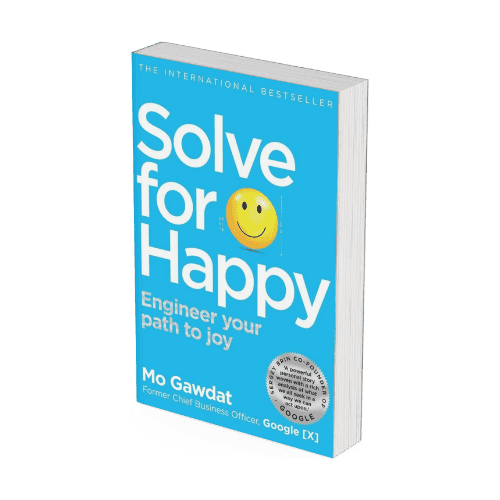
Solve for Happy
by Mo Gawdat
The Author.
Mo Gawdat isn’t the typical self-help writer. For years he held high-level roles at tech companies, especially Chief Business Officer at Google X, the segment of Google that undertakes bold, futuristic projects. Mo is an engineer by trade, serial entrepreneur, and systems-based and solution-focused intellectual man. But that life took a sharp turn when his 21-year-old son, Ali, died suddenly. That tragedy forced him to reflect deeply. He started to question everything he thought he knew about life and feelings and the whole point. From that moment of deep grief and deep love emerged this book, Solve for Happy. And it’s a way in which he says to celebrate and share what he found in the journey with his son. Mo’s voice is cool, grounded and really human. He isn’t condescending. He opens to you the path he takes, not to tell you how to live, but to tell you what he learned when life ceased to matter. About “Solve for Happy”. This book is centered on one, simple idea. Happiness is not random. It’s not luck. That’s something you can work out. Like solving an equation. Mo presents a formula that can be approached as follows: Happiness is equal to or greater than the events of your life minus your expectations of how life should be. That’s it. And it’s a formula that gives you an excuse to stop. Because most of us believe that happiness derives from what happens to us. But Mo flips that thinking. It’s really about how we perceive what happens, he says. And those who have such high or unrealistic expectations will always end up disappointed. But can you reset your expectations or change how you view living? If so, can this help make you feel at peace? The book is divided into a number of useful parts. Mo goes on to show how our minds play tricks on us, how our thoughts lie and how our emotions often trick us into false stories. He introduces six grand illusions, seven blind spots and five ultimate truths which mark the inner world. These are not complex theories or theories on the mind. He writes about them plainly, and explains them with stories, analogy and almost a smidge of humour because he has been trying to use them to help us come to understand. At the heart of the book is Ali. Mo relates to us the story of his son, who was kind and wise and thoughtful far beyond his years. When Ali died in what should have been a routine surgery, Mo was devastated. But instead of becoming bitter, he chose to take tools he had worked on for years. The happiness formula of Ali’s metamorphosis, put to the test by him. And it held up. This isn’t a book filled with phony optimism. It’s grounded. Real. Mo doesn’t deny suffering. He just demonstrates how we are able to bear pain without it derailing how we can experience joy. My Take on “Solve for Happy”. This book landed on you in the best possible way. I am not particularly fond of fluffy self-help advice or spiritual clichés. What I like are things that are practical, honest, and clear. Solve for Happy fits that all. Mo speaks my language. He doesn’t fob his shoulders off and say that if you just smile more or repeat affirmations, all will be fine. He demonstrates that happiness is a mental process, and not a fortunate outcome. The equation he shares showing how your happiness depends on the discrepancy between what you expected and what happens and is something I get to see a lot in my work with clients. It’s not that people are unhappy by definition, but that things don’t go according to how they’re supposed to. Mo’s grief handling is one of the book’s most dynamic moments. Losing a child is perhaps one of the saddest things a person can experience. And yet somehow he continues to be grounded. He is open about the pain, but does not let it consume him. That kind of emotional maturity is hard to come by and provides weight to his words. I also really enjoyed the way he explained how the mind works. His dissection of illusions and blind spots is not merely interesting; it’s helpful. It creates structure around the messy thoughts that people tend to carry into therapy. And since Mo has an engineering background, he has to explain everything in a way that makes sense. You got no fluff, no mysticism, I think just straight talk. And this book reminded me that peace of mind isn’t about fixing everything. It’s about seeing clearly. And clarity is a thing we can all cultivate — even amid a mess. We used to do the same, this text is especially helpful for anyone in therapy or coaching. It gives us the language and tools to support clients bettering themselves. More important it shows us that we can be professionals and we can be humans navigating life, just like everybody else. I remind clients and colleagues to practice what I preach in “Solve for Happy.”
Ask yourself and your clients: at this point, are expectations helping or harming? Teach that a thought is not necessarily always true. Our brain tells stories. Many of them are not worth listening to. For the analytic client, demonstrate that emotions and logic are not opposites. I know this book demonstrates that they can cooperate. Less on the results on the outside and more on the clarity from within. That’s where true happiness resides. Don’t bypass pain. Sit with it. But don’t let that end up being your complete story. In grief work, show that peace and sadness may go together. Mo’s story is evidence of that. Try out the happiness formula during session. And it’s straightforward but can spark meaningful conversations. Discuss the illusions and blind spots with clients. These are working tools rather than theoretical approaches. Choose clarity over comfort. That is the foundation of lasting emotional strength.
In summary.
Solve for Happy is more than just another self-help book. This is a thoughtful honest guide to living through the messiness of reality, clarity and purpose. Mo Gawdat gives us tools that are easy to grasp and powerful tools. This book doesn’t provide false hope. It brings real hope, which you build for yourself.
Solve for happy
by Mo Gawdat
The Author.
Mo Gawdat isn’t the typical self-help writer. For years he held high-level roles at tech companies, especially Chief Business Officer at Google X, the segment of Google that undertakes bold, futuristic projects. Mo is an engineer by trade, serial entrepreneur, and systems-based and solution-focused intellectual man. But that life took a sharp turn when his 21-year-old son, Ali, died suddenly. That tragedy forced him to reflect deeply. He started to question everything he thought he knew about life and feelings and the whole point. From that moment of deep grief and deep love emerged this book, Solve for Happy. And it’s a way in which he says to celebrate and share what he found in the journey with his son. Mo’s voice is cool, grounded and really human. He isn’t condescending. He opens to you the path he takes, not to tell you how to live, but to tell you what he learned when life ceased to matter. About “Solve for Happy”. This book is centered on one, simple idea. Happiness is not random. It’s not luck. That’s something you can work out. Like solving an equation. Mo presents a formula that can be approached as follows: Happiness is equal to or greater than the events of your life minus your expectations of how life should be. That’s it. And it’s a formula that gives you an excuse to stop. Because most of us believe that happiness derives from what happens to us. But Mo flips that thinking. It’s really about how we perceive what happens, he says. And those who have such high or unrealistic expectations will always end up disappointed. But can you reset your expectations or change how you view living? If so, can this help make you feel at peace? The book is divided into a number of useful parts. Mo goes on to show how our minds play tricks on us, how our thoughts lie and how our emotions often trick us into false stories. He introduces six grand illusions, seven blind spots and five ultimate truths which mark the inner world. These are not complex theories or theories on the mind. He writes about them plainly, and explains them with stories, analogy and almost a smidge of humour because he has been trying to use them to help us come to understand. At the heart of the book is Ali. Mo relates to us the story of his son, who was kind and wise and thoughtful far beyond his years. When Ali died in what should have been a routine surgery, Mo was devastated. But instead of becoming bitter, he chose to take tools he had worked on for years. The happiness formula of Ali’s metamorphosis, put to the test by him. And it held up. This isn’t a book filled with phony optimism. It’s grounded. Real. Mo doesn’t deny suffering. He just demonstrates how we are able to bear pain without it derailing how we can experience joy. My Take on “Solve for Happy”. This book landed on you in the best possible way. I am not particularly fond of fluffy self-help advice or spiritual clichés. What I like are things that are practical, honest, and clear. Solve for Happy fits that all. Mo speaks my language. He doesn’t fob his shoulders off and say that if you just smile more or repeat affirmations, all will be fine. He demonstrates that happiness is a mental process, and not a fortunate outcome. The equation he shares showing how your happiness depends on the discrepancy between what you expected and what happens and is something I get to see a lot in my work with clients. It’s not that people are unhappy by definition, but that things don’t go according to how they’re supposed to. Mo’s grief handling is one of the book’s most dynamic moments. Losing a child is perhaps one of the saddest things a person can experience. And yet somehow he continues to be grounded. He is open about the pain, but does not let it consume him. That kind of emotional maturity is hard to come by and provides weight to his words. I also really enjoyed the way he explained how the mind works. His dissection of illusions and blind spots is not merely interesting; it’s helpful. It creates structure around the messy thoughts that people tend to carry into therapy. And since Mo has an engineering background, he has to explain everything in a way that makes sense. You got no fluff, no mysticism, I think just straight talk. And this book reminded me that peace of mind isn’t about fixing everything. It’s about seeing clearly. And clarity is a thing we can all cultivate — even amid a mess. We used to do the same, this text is especially helpful for anyone in therapy or coaching. It gives us the language and tools to support clients bettering themselves. More important it shows us that we can be professionals and we can be humans navigating life, just like everybody else. I remind clients and colleagues to practice what I preach in “Solve for Happy.”
Ask yourself and your clients: at this point, are expectations helping or harming? Teach that a thought is not necessarily always true. Our brain tells stories. Many of them are not worth listening to. For the analytic client, demonstrate that emotions and logic are not opposites. I know this book demonstrates that they can cooperate. Less on the results on the outside and more on the clarity from within. That’s where true happiness resides. Don’t bypass pain. Sit with it. But don’t let that end up being your complete story. In grief work, show that peace and sadness may go together. Mo’s story is evidence of that. Try out the happiness formula during session. And it’s straightforward but can spark meaningful conversations. Discuss the illusions and blind spots with clients. These are working tools rather than theoretical approaches. Choose clarity over comfort. That is the foundation of lasting emotional strength.
In summary.
Solve for Happy is more than just another self-help book. This is a thoughtful honest guide to living through the messiness of reality, clarity and purpose. Mo Gawdat gives us tools that are easy to grasp and powerful tools. This book doesn’t provide false hope. It brings real hope, which you build for yourself.
“True healing occurs when I accept the circumstances of my life and forgive myself.”
Recent Thoughts

Performance Lab Environment for Mental Clarity and Focus
High performers are seldom incompetent. They struggle with carryover. Carryover of stress. Carryover of emotion. Carryover of intensity from one room to another.

High Performance Without Burnout
When work is in the high performers’ way, it is very addictive. They are quick, decisive, disciplined, competitive and outcome-oriented. They raise standards.