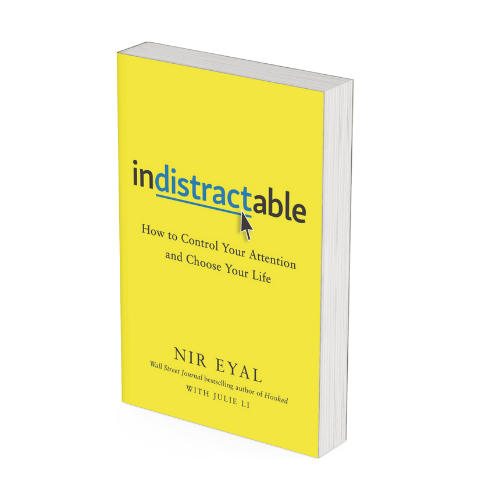
Indistractable by Nir Eyal
by Nir Eyal
Nir Eyal, who wrote best-selling books and gave talks at various conferences worldwide, is a widely known expert in behavioural design and technology. He has spent a great deal of time studying the impact that technology has, as a result of his training in economics and psychology, upon human behaviour and habit formation. His primary function is helping individuals and employers make good use of habit-forming products. If you’re an entrepreneur, designer or product maker who needs to build interesting products, you should read Eyal’s first book, Hooked. His ideas on individual productivity and habit formation make him sound quite well respected because they consist of theoretical work and practical experience.
Nir Eyal’s Indistractable also delves into the psychology of distraction, as well as advice for refocusing and recovering from distraction in an unrelenting world. Distractions, Eyal said, do not come from without; they come from within ourselves–for example through pain or monotony. A detailed plan is laid out by him to manage these distractions and enhance productivity.
This book contains four main sections: learning to control your own emotions and thoughts; prioritising your time wisely; dealing with external influences; and maintaining an attention span. The book combines psychological principles with real-life experiences and exercises, to show how anyone may become “indistractable.” Eyal highlights the social environment and technological environment, which contribute to our inability to concentrate and emphasizes the relevance of being able to manage our desires.
The book covers techniques to resist temptation in various forms: personal stories, research-backed tactics, practical advice on staying on path. Eyal’s inclusive book offers the perfect experience that everyone needs to understand how to be present in their day-to-day life, whether it is in the workplace, in relationships or with their own health and happiness.
And I connected to Indistractable’s story on how it challenges the accepted idea that interruptions are caused by others. Eyal flips the script on us and shows that what is the issue isn’t our phones or notifications, it’s how we can’t control our urges to check them. That creepy feeling that creeps in just before you fall into the YouTube or Instagram vortex and mindlessly scroll? It’s a trigger within yourself. And it is the first step we must take if we are ever to regain our footing again.
One of the book’s more useful recommendations was to use “time blocks” to manage our daily tasks better. Though simple, Eyal emphasizes the connection of these blocks to personal values, in order for productivity to be of authentic use and drive with social values. He focuses on making the most of the present moment while building time support for goals and priorities. Then again, Eyal refrains from critiquing technology but instead recommends pragmatic solutions to make use of technology to curb its ill effects on focus. Instead of recommending isolation, he recommends tweaking notifications, using focus tools and limiting social media time intentionally.
One of the biggest things that I discovered is how to handle distractions, whether they come back to you privately or professionally. What spoke strongly was Eyal’s suggestion to form an “effort pact” with colleagues and loved ones. The author says it is also important to communicate availability and unavailability if we want to remain focused in a connected world. Eyal advises not to set out rules; rather, teach children to self-monitor their tendencies and how to control distractions by themselves So in the end, Indistractable gives readers actual tactics to recognize the distractions they must control and execute realistic solutions to remain focused for long.
Insights from Indistractable for Clients and Friends.
Identify Internal Causes: Pay attention to how bad feelings are frequently when it comes to distractions. It is also important to encourage everyone, including clients, to take some time to find out what makes them want to take diversion.
Use Time Blocks: Help clients and work colleagues with time blocks in a way that enhances their ability to plan their day and accomplish their goals while staying true to their values and what they aspire towards.
Counter Outside Influences: Tell users how to better control their devices by changing alert settings and creating a setting that promotes rather than discourages focus.
Make Effort Pacts: Help clients get clear with their availability and distraction levels and ask them to make “effort pacts” with friends, family, or colleagues.
Enhance Technology Use: Assist clients in the understanding that technology can be utilized in a mindful way. Give some tips for making more use of digital resources.
Teach Kids to Self-Regulate: Instead of enforcing strict screen-time restrictions, your colleagues who support parents should be advocating the concept of teaching kids self-regulation skills. Focus Is Not Something That Is Built Into Us, It Is a Skill That You Can Practice and Practice.
Focus on What Is Important: Ask clients to consider their core values and make certain that they really think through and prioritise what truly matters in their everyday lives.
Nir Eyal’s Indistractable offers not only an insightful look at why we get distracted but gives others a pathway out of that chaos. Why do so many others feel this way today? For better ways to manage your attention, Eyal shares feasible science-based interventions. If you want to do a better job and control your time, this is a must.
Indistractable by Nir Eyal
by Nir Eyal
Nir Eyal, who wrote best-selling books and gave talks at various conferences worldwide, is a widely known expert in behavioural design and technology. He has spent a great deal of time studying the impact that technology has, as a result of his training in economics and psychology, upon human behaviour and habit formation. His primary function is helping individuals and employers make good use of habit-forming products. If you’re an entrepreneur, designer or product maker who needs to build interesting products, you should read Eyal’s first book, Hooked. His ideas on individual productivity and habit formation make him sound quite well respected because they consist of theoretical work and practical experience.
Nir Eyal’s Indistractable also delves into the psychology of distraction, as well as advice for refocusing and recovering from distraction in an unrelenting world. Distractions, Eyal said, do not come from without; they come from within ourselves–for example through pain or monotony. A detailed plan is laid out by him to manage these distractions and enhance productivity.
This book contains four main sections: learning to control your own emotions and thoughts; prioritising your time wisely; dealing with external influences; and maintaining an attention span. The book combines psychological principles with real-life experiences and exercises, to show how anyone may become “indistractable.” Eyal highlights the social environment and technological environment, which contribute to our inability to concentrate and emphasizes the relevance of being able to manage our desires.
The book covers techniques to resist temptation in various forms: personal stories, research-backed tactics, practical advice on staying on path. Eyal’s inclusive book offers the perfect experience that everyone needs to understand how to be present in their day-to-day life, whether it is in the workplace, in relationships or with their own health and happiness.
And I connected to Indistractable’s story on how it challenges the accepted idea that interruptions are caused by others. Eyal flips the script on us and shows that what is the issue isn’t our phones or notifications, it’s how we can’t control our urges to check them. That creepy feeling that creeps in just before you fall into the YouTube or Instagram vortex and mindlessly scroll? It’s a trigger within yourself. And it is the first step we must take if we are ever to regain our footing again.
One of the book’s more useful recommendations was to use “time blocks” to manage our daily tasks better. Though simple, Eyal emphasizes the connection of these blocks to personal values, in order for productivity to be of authentic use and drive with social values. He focuses on making the most of the present moment while building time support for goals and priorities. Then again, Eyal refrains from critiquing technology but instead recommends pragmatic solutions to make use of technology to curb its ill effects on focus. Instead of recommending isolation, he recommends tweaking notifications, using focus tools and limiting social media time intentionally.
One of the biggest things that I discovered is how to handle distractions, whether they come back to you privately or professionally. What spoke strongly was Eyal’s suggestion to form an “effort pact” with colleagues and loved ones. The author says it is also important to communicate availability and unavailability if we want to remain focused in a connected world. Eyal advises not to set out rules; rather, teach children to self-monitor their tendencies and how to control distractions by themselves So in the end, Indistractable gives readers actual tactics to recognize the distractions they must control and execute realistic solutions to remain focused for long.
Insights from Indistractable for Clients and Friends.
Identify Internal Causes: Pay attention to how bad feelings are frequently when it comes to distractions. It is also important to encourage everyone, including clients, to take some time to find out what makes them want to take diversion.
Use Time Blocks: Help clients and work colleagues with time blocks in a way that enhances their ability to plan their day and accomplish their goals while staying true to their values and what they aspire towards.
Counter Outside Influences: Tell users how to better control their devices by changing alert settings and creating a setting that promotes rather than discourages focus.
Make Effort Pacts: Help clients get clear with their availability and distraction levels and ask them to make “effort pacts” with friends, family, or colleagues.
Enhance Technology Use: Assist clients in the understanding that technology can be utilized in a mindful way. Give some tips for making more use of digital resources.
Teach Kids to Self-Regulate: Instead of enforcing strict screen-time restrictions, your colleagues who support parents should be advocating the concept of teaching kids self-regulation skills. Focus Is Not Something That Is Built Into Us, It Is a Skill That You Can Practice and Practice.
Focus on What Is Important: Ask clients to consider their core values and make certain that they really think through and prioritise what truly matters in their everyday lives.
Nir Eyal’s Indistractable offers not only an insightful look at why we get distracted but gives others a pathway out of that chaos. Why do so many others feel this way today? For better ways to manage your attention, Eyal shares feasible science-based interventions. If you want to do a better job and control your time, this is a must.
supported by science. If you want to be more productive and master your time, this is a book you must read.
“True healing occurs when I accept the circumstances of my life and forgive myself.”
Recent Thoughts

Performance Lab Environment for Mental Clarity and Focus
High performers are seldom incompetent. They struggle with carryover. Carryover of stress. Carryover of emotion. Carryover of intensity from one room to another.

High Performance Without Burnout
When work is in the high performers’ way, it is very addictive. They are quick, decisive, disciplined, competitive and outcome-oriented. They raise standards.