
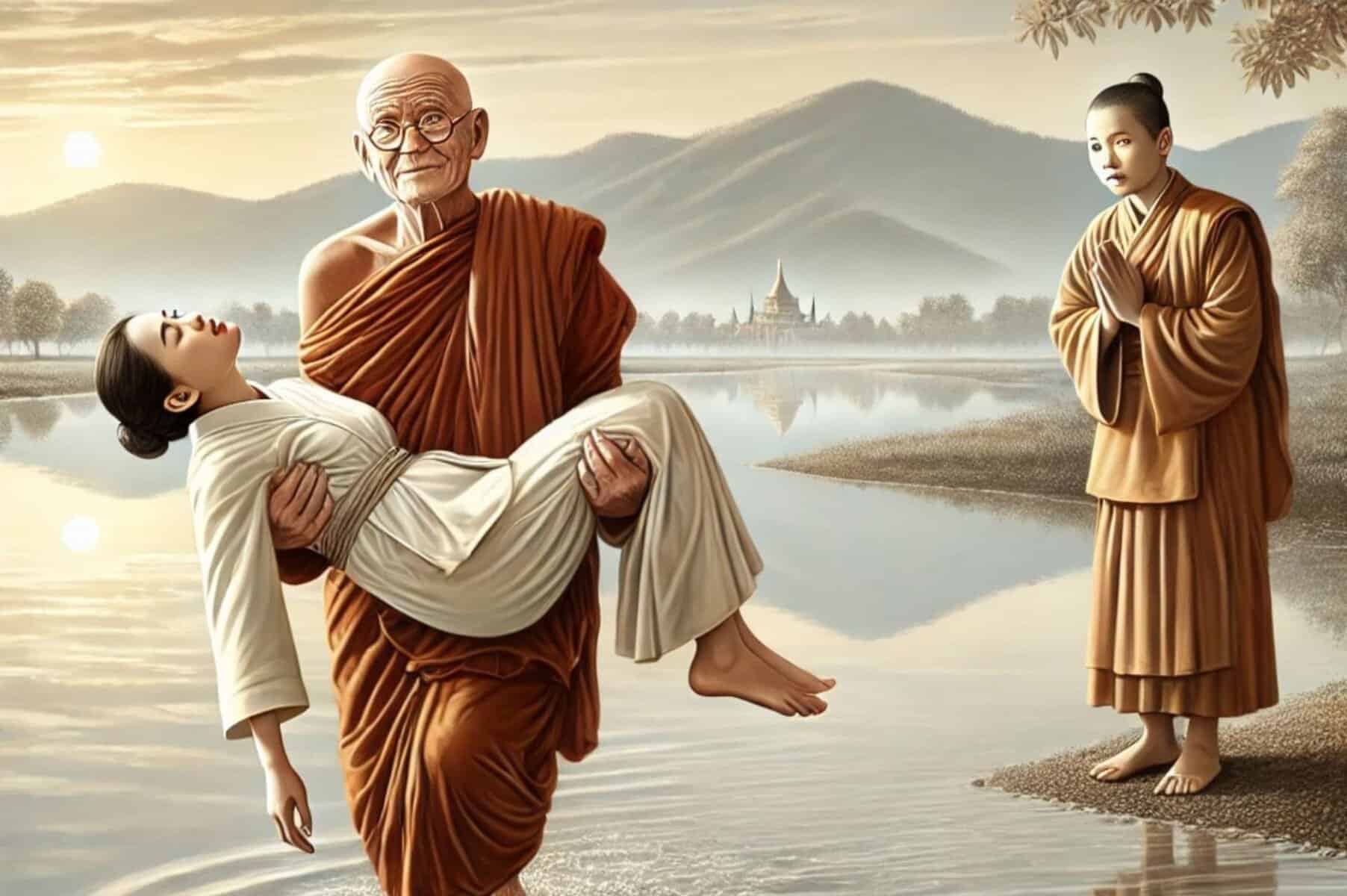
Once, two monks traveled together — an older one and a younger. Along the way they stumbled upon a river with a mighty current. A woman was at the river, unable to cross unaided. She asked the monks if they could help her.
The older monk without hesitation picked the woman up, carried her across the river and gently placed her to rest on the other side of the river. But this shocked the younger monk. They were, after all, monks who had taken vows not to touch women. He kept his tongue at first, but couldn’t stop thinking as they made their way down the road. After a few hours of silent walking, the younger monk could not control it anymore. He said, “How could you carry that woman across the river? We are monks, and you know we’re not supposed to do that!” The older monk spun around and replied to him calmly, “I put the woman down hours ago. Why are you still carrying her?”
Lessons
Take for example the story of the two monks, when one bears a woman across a river and then releases her as the other contemplates it on the river: These stories both embody profound emotional, relationship and developmental lessons. Here’s some that we can extract from it, providing examples that apply to us on a day-to-day basis:
Reconsider and Give Up Resentment – Consider someone your partner or a staff member who had hurt you. You can easily get hurt, but the more you keep holding on to that resentment, the more you pile more weight on your shoulders to go to the next stage in life. Like the older monk who moved on after helping the woman, we too are free to let go of bitterness. Forgiving, or letting go, allows us to be free from the needlessly heavy burdens.
Stay in the Here and Now – You possibly had a co-worker stealing credit for your ideas at work. Replaying this story distracts you; it lowers productivity. The younger monk’s inflexibility reflects just how much we might lose our peace for the past we keep with us. That’s actually not the case, in fact, since holding onto the present and refraining from retracing the past wounds keeps us grounded and helps us get there.
Know when to grow up – we always hold on to relationships or things over too long and we believe things will change later. The older monk accomplished what was required of him and then moved on. This is when learning how to be willing to let go comes in, whether it be a friendship, a job, or an agenda that no longer serves us. Sticking to what takes our energy keeps us from investing in what is really valuable.
Don’t Burden Yourself with Others’ Judgements – Sometimes we have to worry about others’ impressions of our decisions. The response of the young monk focused on his criticism of the older monk’s action. In real life we are free to choose wisely without anyone’s judgment. We must, as the older monk, put our values on the agenda and relinquish the desire for endless validation.
This Is Where Compassion Meets Compassion: Treat With It For It Doesn’t Matter – Sometimes, others will ask why you will respond with compassion, especially if the first time a second chance is offered. Similar to the younger monk questioning the older one, people might ask you about your choices. This story tells us that if compassion feels right to us, it’s okay, even if others do not understand. Being true to our values and providing kindness are individual choice.
Think About Why Things Are Bad for You – You need to spend a moment when you’re feeling like something sucks in your life (a bad day at work, a problem with your family) to ask yourself why it might be. When he explained when he was upset, that young monk didn’t realise it in question, offering a fresh perspective. A key skill is for self-reflection, so that we find an answer to the problem, and can move on with more wisdom.
The tale invites us to release extraneous loads, attend to what’s before us, and respond with kindness and insight. Instead of treating what doesn’t serve us with this heavy weight, that sort of thing has more room left for peace and growth.
Share this Blog
Recent Thoughts

Rumours, Noise and Real Growth: Learning to Keep My Eyes on the Road
Matthew is a closeted gay.” “Matthew jumps from woman to woman.” “He’s money-minded.” “I’ve heard he sees women for free if they ‘offer

Ikigai vs. Workaholism: Why I’ve Given Up Perfectionism and Workaholic Tendencies
1) Confronting Challenges. Throughout my career, I've always faced problems head-on. Being straightforward in tough situations is part of who I am. While