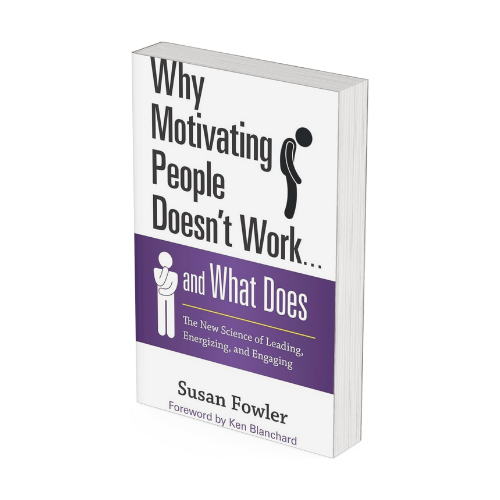
Why Motivating People Doesn’t Work and What Does
by Susan Fowler
Susan Fowler is a life-long research-driven approach leader and motivation expert. She is a senior consulting partner at The Ken Blanchard Companies and has worked with the world’s leading organizational champions to enhance workplace motivation and engagement. Fowler draws on self-determination theory, the study on how people form intrinsic motivation. She feels that rewards, incentives and pressure are traditional means of motivation that will fail over time and that leadership requires a totally new approach in order to instigate motivation. She refutes old managers’ techniques in her books, keynotes and workshops and offers a research-based framework for sustainable motivation.
Susan Fowler’s Why Motivating People Doesn’t Work and What Does questions old assumptions businesses and leaders may have about how they aim to motivate their employees. External motivators — awards, bonuses, fear-based tactics, and so forth — don’t produce long-term engagement or performance, she says. Instead, they can contribute to short-term compliance and burnout. Fowler’s book is based on the theory of self-determination which identifies three psychological needs that are responsible for genuine sustained motivation:
Autonomy: The desire to feel that we can define our own choices.
Relatedness: We simply want to feel connected with and have connections to other people.
Competence: The requirement to feel competent and effective in what we do.
She says that once people have these three needs fulfilled at their core, they are intrinsically motivated, that is they labor hard because they want to do it, not because someone talks them into doing it, they are bribed, threatened, whatever. The issue with most motivational strategies in the workplace is its emphasis on controlling people, rather than fostering individuals’ intrinsic desire to succeed.
Fowler also discusses the Optimal Motivation Framework, which guides leaders away from externally focused motivators (carrots and sticks) and focuses on their employees’ intrinsic motivation. Here, she offers realistic tools that could help managers engage in more motivational conversations, foster a climate of dignity among employees and shift from the old school management methods that depend on pressure and rewards.
The book’s central message is that sustainable motivation is not something leaders cause people but rather something they create the conditions for. The best motivation comes from within, and the job of a leader is to provide opportunities for people to succeed. Many companies stick to such old-timey tactics as bonuses, threats, and enforced competition in order to bring success. But this book proves these methods simply don’t work in the longer run. It is entirely understandable; when people are under pressure to perform, they may accept for a time but then simply burn out or go MIA.
So what stood back to me was the focus on autonomy, relatedness and competence. These are fundamental human needs and humans naturally become more attuned when it is satisfied. But many workplaces kill motivation by being too micromanaging, creating toxic environments or failing to give employees a chance for advancement. Fowler’s message of motivation is simple: people “don’t gotta be ‘pulled forward’ by force. But they do not want to feel that they cannot motivate themselves.
I like that this book is too great for theory. Fowler does not merely advise leaders on what’s not to do; she provides a map on what does work. Her best-practice framework of motivation is something that any leader, coach, and manager will use. Rather than treating employees as if they can be manipulated for external rewards, leaders have to be asking:
Are my workers opting to do what their values align with? (Autonomy).
Is their feeling of connection to their colleagues and work? (Relatedness).
Are they able to learn and grow? (Competence).
Whether you’re a manager, coach, therapist, or parent, understanding real motivation is key. It’s a change from control to support, from pressure to empowerment.
That doesn’t make this transition easy, however. Rewarding and punishing employees as motivation becomes deeply rooted in the way most workplaces operate. But it’s not straightforward to break these ways and start leading in ways that engage people. But the payoff is worth it. People with positive motivations not only work better, they are happier, imaginative and loyal. This is a wake-up call story for people struggling with obsolete mechanisms of motivation. Fowler’s insights go a long way toward establishing a team or organization where employees are engaged for the right reasons. I would advise clients to follow along with and colleagues in bringing “Why Motivating People Doesn’t Work and What Does to bear.” with them.
This book offers some big takeaways I should teach coaches, therapists, and leaders, all of whom work with people:
They generate short-term compliance, not long-term engagement.
Focus on autonomy. Enable people to make choices in alignment with their values. Micromanagement kills motivation.
Create a sense of belonging. People must feel engaged with their work and colleagues.
Assist individuals in acquiring expertise. Intrinsic motivation is fueled mostly by learning and growth. Let employees advance in skills.
Facilitate increased motivation conversations. Instead of trying to use extrinsic rewards to shove people toward their goals, connect what they’re doing with what they care about.
Understanding the difference between compliance and commitment. Following orders does not mean someone is serious, just because someone does what they are told doesn’t mean they are really engaged.
Lead with empathy, not power. The best leaders build an environment where people can naturally thrive.
Keep in mind that motivation is not one-time act. It’s a sustained process of satisfying people’s psychological needs.
Apply these principles in a new context of work. These are ideas that don’t exist solely in the workplace. Real motivation can have much to say for parents, teachers, coaches and everyone.
If we can reorient the way we conceptualize motivation, healthy more productive workplaces and relationships will result.
In Summary.
Why Motivating People Doesn’t Work and What Does is a workhorse for leadership, coaching, and personal development in the 21st century. Dr. Susan Fowler demonstrates classic motivational mechanisms such as rewards and pressure will work less well over time and offer an alternative model of motivation based on autonomy, relatedness and competence. If we want that we should stop “motivating” people and instead cultivate an environment in which they can motivate themselves. This is a must read for anyone who wishes to inspire a commitment and even more so a desire to be motivated.
Why Motivating People Doesn’t Work and What Does
by Susan Fowler
Susan Fowler is a life-long research-driven approach leader and motivation expert. She is a senior consulting partner at The Ken Blanchard Companies and has worked with the world’s leading organizational champions to enhance workplace motivation and engagement. Fowler draws on self-determination theory, the study on how people form intrinsic motivation. She feels that rewards, incentives and pressure are traditional means of motivation that will fail over time and that leadership requires a totally new approach in order to instigate motivation. She refutes old managers’ techniques in her books, keynotes and workshops and offers a research-based framework for sustainable motivation.
Susan Fowler’s Why Motivating People Doesn’t Work and What Does questions old assumptions businesses and leaders may have about how they aim to motivate their employees. External motivators — awards, bonuses, fear-based tactics, and so forth — don’t produce long-term engagement or performance, she says. Instead, they can contribute to short-term compliance and burnout. Fowler’s book is based on the theory of self-determination which identifies three psychological needs that are responsible for genuine sustained motivation:
Autonomy: The desire to feel that we can define our own choices.
Relatedness: We simply want to feel connected with and have connections to other people.
Competence: The requirement to feel competent and effective in what we do.
She says that once people have these three needs fulfilled at their core, they are intrinsically motivated, that is they labor hard because they want to do it, not because someone talks them into doing it, they are bribed, threatened, whatever. The issue with most motivational strategies in the workplace is its emphasis on controlling people, rather than fostering individuals’ intrinsic desire to succeed.
Fowler also discusses the Optimal Motivation Framework, which guides leaders away from externally focused motivators (carrots and sticks) and focuses on their employees’ intrinsic motivation. Here, she offers realistic tools that could help managers engage in more motivational conversations, foster a climate of dignity among employees and shift from the old school management methods that depend on pressure and rewards.
The book’s central message is that sustainable motivation is not something leaders cause people but rather something they create the conditions for. The best motivation comes from within, and the job of a leader is to provide opportunities for people to succeed. Many companies stick to such old-timey tactics as bonuses, threats, and enforced competition in order to bring success. But this book proves these methods simply don’t work in the longer run. It is entirely understandable; when people are under pressure to perform, they may accept for a time but then simply burn out or go MIA.
So what stood back to me was the focus on autonomy, relatedness and competence. These are fundamental human needs and humans naturally become more attuned when it is satisfied. But many workplaces kill motivation by being too micromanaging, creating toxic environments or failing to give employees a chance for advancement. Fowler’s message of motivation is simple: people “don’t gotta be ‘pulled forward’ by force. But they do not want to feel that they cannot motivate themselves.
I like that this book is too great for theory. Fowler does not merely advise leaders on what’s not to do; she provides a map on what does work. Her best-practice framework of motivation is something that any leader, coach, and manager will use. Rather than treating employees as if they can be manipulated for external rewards, leaders have to be asking:
Are my workers opting to do what their values align with? (Autonomy).
Is their feeling of connection to their colleagues and work? (Relatedness).
Are they able to learn and grow? (Competence).
Whether you’re a manager, coach, therapist, or parent, understanding real motivation is key. It’s a change from control to support, from pressure to empowerment.
That doesn’t make this transition easy, however. Rewarding and punishing employees as motivation becomes deeply rooted in the way most workplaces operate. But it’s not straightforward to break these ways and start leading in ways that engage people. But the payoff is worth it. People with positive motivations not only work better, they are happier, imaginative and loyal. This is a wake-up call story for people struggling with obsolete mechanisms of motivation. Fowler’s insights go a long way toward establishing a team or organization where employees are engaged for the right reasons. I would advise clients to follow along with and colleagues in bringing “Why Motivating People Doesn’t Work and What Does to bear.” with them.
This book offers some big takeaways I should teach coaches, therapists, and leaders, all of whom work with people:
They generate short-term compliance, not long-term engagement.
Focus on autonomy. Enable people to make choices in alignment with their values. Micromanagement kills motivation.
Create a sense of belonging. People must feel engaged with their work and colleagues.
Assist individuals in acquiring expertise. Intrinsic motivation is fueled mostly by learning and growth. Let employees advance in skills.
Facilitate increased motivation conversations. Instead of trying to use extrinsic rewards to shove people toward their goals, connect what they’re doing with what they care about.
Understanding the difference between compliance and commitment. Following orders does not mean someone is serious, just because someone does what they are told doesn’t mean they are really engaged.
Lead with empathy, not power. The best leaders build an environment where people can naturally thrive.
Keep in mind that motivation is not one-time act. It’s a sustained process of satisfying people’s psychological needs.
Apply these principles in a new context of work. These are ideas that don’t exist solely in the workplace. Real motivation can have much to say for parents, teachers, coaches and everyone.
If we can reorient the way we conceptualize motivation, healthy more productive workplaces and relationships will result.
In Summary.
Why Motivating People Doesn’t Work and What Does is a workhorse for leadership, coaching, and personal development in the 21st century. Dr. Susan Fowler demonstrates classic motivational mechanisms such as rewards and pressure will work less well over time and offer an alternative model of motivation based on autonomy, relatedness and competence. If we want that we should stop “motivating” people and instead cultivate an environment in which they can motivate themselves. This is a must read for anyone who wishes to inspire a commitment and even more so a desire to be motivated.
“In the middle of difficulty lies opportunity.”
Recent Thoughts

Performance Lab Environment for Mental Clarity and Focus
High performers are seldom incompetent. They struggle with carryover. Carryover of stress. Carryover of emotion. Carryover of intensity from one room to another.

High Performance Without Burnout
When work is in the high performers’ way, it is very addictive. They are quick, decisive, disciplined, competitive and outcome-oriented. They raise standards.