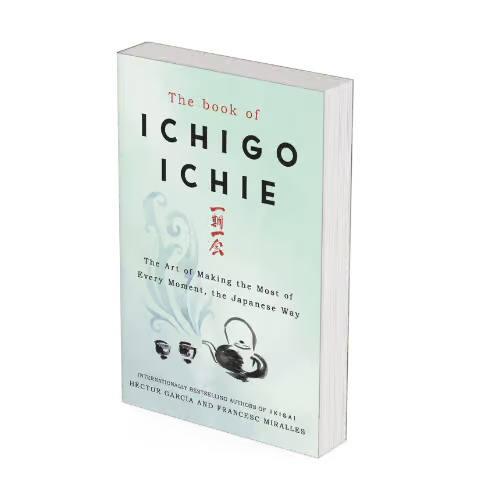
The Book of Ichigo Ichie by Francesc Miralles & Héctor García
The Author.
Francesc Miralles and Héctor García are best known for blending Eastern philosophy with Western practicality that resonates. Héctor is a professional engineer and long-term resident of Japan, while Francesc is a writer interested in personal growth and mindfulness. Together, they also co-authored Ikigai, another book about Japanese wisdom. In The Book of Ichigo Ichie, they explore a lesser-known but meaningful Japanese concept: appreciating each moment as if it will never come again. They write simply and clearly, grounded in real life—not airy, not preachy, just useful and grounded.
Summary of the Book of Ichigo Ichie.
Ichigo ichie is a Japanese phrase meaning roughly “one time, one meeting.” The concept is this: every encounter, every second, every experience is unique and will never happen again in the same way. Once it’s gone, it’s gone. That may be a little sad, but in fact, it’s liberating. It constantly reminds me to be present, treating each hour as a precious time in your life.
The book explains this concept through stories, philosophy, and practical suggestions. The result is a kind of wisdom that is powerful. The authors connect ichigo ichie with mindfulness, presence, and even neuroscience, explaining how our brains are programmed to miss the present because we are constantly distracted or in the middle of something else. They illustrate how slowing down and simply focusing on the moment can decrease regret, anxiety, and numbness.
There is obviously a focus on making human interaction. Every conversation, every coffee we share, every goodbye, you’ll never get that version of it again. The invitation, then, is to show up fully, listen well, and stop multitasking your way through life.
It also details how ichigo ichie is reflected in Japanese tea ceremonies, art, and greetings and goodbyes. There’s a quiet beauty in how they approach the everyday seriously. The authors provide examples of how to incorporate this awareness into the rhythms of daily life, from our intentions at the beginning of the day to our decision-making when we close meetings, relationships, parts of our lives.
It’s about training yourself to notice more, take less for granted, and learn to appreciate more.
My thoughts on “The Book of Ichigo Ichie”.
I found this book so relatable because when you listen to it, it stands out from the background noise. And it doesn’t shout at you; it’s a gentle reminder to remember a basic, timeless truth that humans all share deep inside but often neglect: this moment will never return. That truth can scare you or awaken you. On a personal level, I’d say it should wake you up.
What I really liked is that it doesn’t require an entirely new life to be changed. You’re not expected to quit your career or meditate for hours on end. It’s about how you show up. Now, when you’re sitting across from someone, are you even there? Or are you already thinking about what happens next?
A lot of my clients’ pain comes from a place in history and a concern for the future. Now is a year for the truth. This book compels us to return to now, because this is really the only time before actual events happen.
That each encounter should be treated as though it were the only one you’ll ever have struck a deep chord. Just imagine what relationships could be if that’s the route we actually took. If we could listen to that voice again and listen like we would never hear it again. If we hugged, it would likely be the last. It’s not about fear, but it sounds heavy. It’s about presence. And that kind of presence changes the game.
I also found it impressive the way the book talked about endings, not as failures but as natural and necessary. So often, we don’t just ignore goodbyes or pretend that things won’t change. But they do. Ichigo ichie teaches you to meet those endings with grace, not panic. This book is about less. It’s about doing less, but doing it with absolute attention. That is the wisdom I respect and believe in, no fluff, no hype, only a summons to be real.
I urge everyone at work and with clients to include teachings from The Book of Ichigo Ichie.
Help clients fully experience sessions, phones off, thoughts grounded, no hurry into repairs. Promote the idea that each encounter, no matter how small it seems, is significant.
You can introduce ichigo ichie for relationships as a mindset: you should listen deeply, not multitask, and be yourself.
Use it to comfort anxiety-ridden clients, saying that existing here and now helps prevent future fear.
Allow our clients to relinquish control and perfectionism.
The moment does not have to be perfect before it is precious.
Reassure people that life is full of endings, and that’s not an issue.
It’s what gives moments their strength.
Use it with grief work.
Learning to appreciate the “one-time-ness” of moments helps clients process loss with less regret.
Open and close sessions purposefully in groups or workshops, making the time unique.
For therapists and coaches: pay more attention to your presence.
Be the calm in the room. Make space for silence. Not every second must be filled. Sometimes presence speaks louder than words.
In summary.
The Book of Ichigo Ichie is a quiet yet powerful reminder that all that matters is not because it is dramatic or perfect, but because it will never happen again. Francesc Miralles and Héctor García do more than theorize. They provide a way to live more awake, more connected, and more at peace with the passing of time.
The Book of Ichigo Ichie by Francesc Miralles & Héctor García
The Author.
Francesc Miralles and Héctor García are best known for blending Eastern philosophy with Western practicality that resonates. Héctor is a professional engineer and long-term resident of Japan, while Francesc is a writer interested in personal growth and mindfulness. Together, they also co-authored Ikigai, another book about Japanese wisdom. In The Book of Ichigo Ichie, they explore a lesser-known but meaningful Japanese concept: appreciating each moment as if it will never come again. They write simply and clearly, grounded in real life—not airy, not preachy, just useful and grounded.
Summary of the Book of Ichigo Ichie.
Ichigo ichie is a Japanese phrase meaning roughly “one time, one meeting.” The concept is this: every encounter, every second, every experience is unique and will never happen again in the same way. Once it’s gone, it’s gone. That may be a little sad, but in fact, it’s liberating. It constantly reminds me to be present, treating each hour as a precious time in your life.
The book explains this concept through stories, philosophy, and practical suggestions. The result is a kind of wisdom that is powerful. The authors connect ichigo ichie with mindfulness, presence, and even neuroscience, explaining how our brains are programmed to miss the present because we are constantly distracted or in the middle of something else. They illustrate how slowing down and simply focusing on the moment can decrease regret, anxiety, and numbness.
There is obviously a focus on making human interaction. Every conversation, every coffee we share, every goodbye, you’ll never get that version of it again. The invitation, then, is to show up fully, listen well, and stop multitasking your way through life.
It also details how ichigo ichie is reflected in Japanese tea ceremonies, art, and greetings and goodbyes. There’s a quiet beauty in how they approach the everyday seriously. The authors provide examples of how to incorporate this awareness into the rhythms of daily life, from our intentions at the beginning of the day to our decision-making when we close meetings, relationships, parts of our lives.
It’s about training yourself to notice more, take less for granted, and learn to appreciate more.
My thoughts on “The Book of Ichigo Ichie”.
I found this book so relatable because when you listen to it, it stands out from the background noise. And it doesn’t shout at you; it’s a gentle reminder to remember a basic, timeless truth that humans all share deep inside but often neglect: this moment will never return. That truth can scare you or awaken you. On a personal level, I’d say it should wake you up.
What I really liked is that it doesn’t require an entirely new life to be changed. You’re not expected to quit your career or meditate for hours on end. It’s about how you show up. Now, when you’re sitting across from someone, are you even there? Or are you already thinking about what happens next?
A lot of my clients’ pain comes from a place in history and a concern for the future. Now is a year for the truth. This book compels us to return to now, because this is really the only time before actual events happen.
That each encounter should be treated as though it were the only one you’ll ever have struck a deep chord. Just imagine what relationships could be if that’s the route we actually took. If we could listen to that voice again and listen like we would never hear it again. If we hugged, it would likely be the last. It’s not about fear, but it sounds heavy. It’s about presence. And that kind of presence changes the game.
I also found it impressive the way the book talked about endings, not as failures but as natural and necessary. So often, we don’t just ignore goodbyes or pretend that things won’t change. But they do. Ichigo ichie teaches you to meet those endings with grace, not panic. This book is about less. It’s about doing less, but doing it with absolute attention. That is the wisdom I respect and believe in, no fluff, no hype, only a summons to be real.
I urge everyone at work and with clients to include teachings from The Book of Ichigo Ichie.
Help clients fully experience sessions, phones off, thoughts grounded, no hurry into repairs. Promote the idea that each encounter, no matter how small it seems, is significant.
You can introduce ichigo ichie for relationships as a mindset: you should listen deeply, not multitask, and be yourself.
Use it to comfort anxiety-ridden clients, saying that existing here and now helps prevent future fear.
Allow our clients to relinquish control and perfectionism.
The moment does not have to be perfect before it is precious.
Reassure people that life is full of endings, and that’s not an issue.
It’s what gives moments their strength.
Use it with grief work.
Learning to appreciate the “one-time-ness” of moments helps clients process loss with less regret.
Open and close sessions purposefully in groups or workshops, making the time unique.
For therapists and coaches: pay more attention to your presence.
Be the calm in the room. Make space for silence. Not every second must be filled. Sometimes presence speaks louder than words.
In summary.
The Book of Ichigo Ichie is a quiet yet powerful reminder that all that matters is not because it is dramatic or perfect, but because it will never happen again. Francesc Miralles and Héctor García do more than theorize. They provide a way to live more awake, more connected, and more at peace with the passing of time.
“A man becomes a man when a man is needed. I’ve seen 40-year-old children cause a man was never needed”
Recent Thoughts

Performance Lab Environment for Mental Clarity and Focus
High performers are seldom incompetent. They struggle with carryover. Carryover of stress. Carryover of emotion. Carryover of intensity from one room to another.

High Performance Without Burnout
When work is in the high performers’ way, it is very addictive. They are quick, decisive, disciplined, competitive and outcome-oriented. They raise standards.