
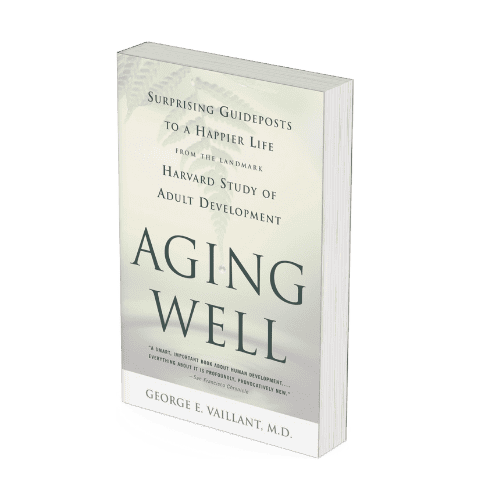
Aging Well by George E. Vaillant.
The Author.
George E. Vaillant is a psychiatrist, professor and one of the world’s leading researchers on adult development and mental health. He’s most famous for leading the Harvard Study of Adult Development, one of the longest-running studies of human life ever, following participants for over 70 years. Vaillant’s research is focused on what really predicts happiness, health and resilience over the whole life course. His findings are based on decades of actual data about humans, not any theory or trends. He is revered for debunking myths about success, aging and mental health and for focusing on emotional maturity, relationships and meaning rather than wealth or status.
Summary of Aging Well.
Aging Well is a robust, research-driven examination of the ways in which aging actually makes lives richer and more meaningful as people age. Culled from the Harvard Study of Adult Development, George Vaillant goes into detail about the lives of hundreds of men over years, what some lived and what others didn’t, struggling in all aspects: physical, emotional, relationship.
The book’s fundamental message is both straightforward and profound: Aging well is less about genes and success than emotional health and relationships. Vaillant demonstrates that fame, money, intelligence, and social class don’t matter as much as the quality of one’s relationships and the ability to withstand stress.
Focusing on adaptation and defense mechanisms is one of the book’s key contributions. Vaillant notes that established defenses: humor, altruism, anticipation, and suppression, that are mature and persistent are robust predictors of long term well-being. Those who adapted, accepted reality and dealt with stress in non-denialist and non-blaming ways were more likely to age well.
Vaillant also debunks the fable that aging results in decline. Physical aging is inevitable; emotional growth can outlive it. For many respondents, older people increased feelings of comfort, wisdom and emotional strength as they reached old age, especially if those people put themselves into the relationships and meaning of other life experiences rather than what they achieved.
One key theme is the importance of love and connection. Vaillant famously concludes “happiness is love. Full stop.” Having stable, caring interactions: romantic, familial and social ones, was the biggest predictor of life satisfaction and health.
The book also examines trauma, addiction, mental illness and failure, demonstrating how early adversity does not kill a person, but unmanaged stress and isolation do. Aging well, according to Vaillant, is a matter of how people react to life, and not what is done to them.
My Thoughts on Aging Well.
All that is deeply grounding with this book. It cuts through the rhetoric of self-help culture and helps remind us of what means the most. I love Aging Well because it is not motivational vacuousness, it’s real, and decades of data on aging is behind it.
What is most surprising, perhaps, is how uncomfortable the truth can be. Much of our life revolves around success, productivity, and status, with happiness as a distant destiny. Vaillant demonstrates, with clarity and repetition, that relationships and emotional maturity are the only currency of a good life.
I also appreciate how honest the book is about pain, addiction and failure. This isn’t a romanticized version of aging. Most lives in the study were messy, disappointing and difficult. And still, the people who became accustomed to adapt, to forgive, to accept, to connect, often experienced peace later in life.
Practically speaking, this book proves something that I say and preach over and over again in my work: People don’t suffer most from what happened to them, but from how alone they feel carrying it. Growing older well isn’t so much about avoiding pain as it is about coping with it without bitterness or shutting down.
And this book is also a quiet warning. If someone is emotionally rigid, isolated, addicted or aloof in midlife, that is the kind of thing that aging is going to make worse. Aging doesn’t repair what we avoid, it reveals it.
And if you’re open to looking straight at your relationships, coping patterns and emotional habits, this book can be both sobering and hopeful.
What I would like my own patients and colleagues, to know from this book:
Relationships can be more important than getting ahead or being wise. Long-term happiness is linked to emotional maturity. Learn healthy ways to cope with stress and disappointment. Addiction and avoidance don’t age well. And we know that humor, flexibility and acceptance are strong tools. Loneliness, like many illnesses, is more deadly. At every stage of life, meaning and purpose are important. Emotionally, it’s never too late to expand. Aging lays bare who we are, it doesn’t make us different. Invest in people, not just accomplishments.
In conclusion, Aging Well is a very practical and research-based reminder to all ages that great love, connection, and emotional resilience are the basic elements of the good life. George Vaillant knows that old age can bring wisdom and peace—if you are willing to grow with time.
Aging Well by George E. Vaillant.
The Author.
George E. Vaillant is a psychiatrist, professor and one of the world’s leading researchers on adult development and mental health. He’s most famous for leading the Harvard Study of Adult Development, one of the longest-running studies of human life ever, following participants for over 70 years. Vaillant’s research is focused on what really predicts happiness, health and resilience over the whole life course. His findings are based on decades of actual data about humans, not any theory or trends. He is revered for debunking myths about success, aging and mental health and for focusing on emotional maturity, relationships and meaning rather than wealth or status.
Summary of Aging Well.
Aging Well is a robust, research-driven examination of the ways in which aging actually makes lives richer and more meaningful as people age. Culled from the Harvard Study of Adult Development, George Vaillant goes into detail about the lives of hundreds of men over years, what some lived and what others didn’t, struggling in all aspects: physical, emotional, relationship.
The book’s fundamental message is both straightforward and profound: Aging well is less about genes and success than emotional health and relationships. Vaillant demonstrates that fame, money, intelligence, and social class don’t matter as much as the quality of one’s relationships and the ability to withstand stress.
Focusing on adaptation and defense mechanisms is one of the book’s key contributions. Vaillant notes that established defenses: humor, altruism, anticipation, and suppression, that are mature and persistent are robust predictors of long term well-being. Those who adapted, accepted reality and dealt with stress in non-denialist and non-blaming ways were more likely to age well.
Vaillant also debunks the fable that aging results in decline. Physical aging is inevitable; emotional growth can outlive it. For many respondents, older people increased feelings of comfort, wisdom and emotional strength as they reached old age, especially if those people put themselves into the relationships and meaning of other life experiences rather than what they achieved.
One key theme is the importance of love and connection. Vaillant famously concludes “happiness is love. Full stop.” Having stable, caring interactions: romantic, familial and social ones, was the biggest predictor of life satisfaction and health.
The book also examines trauma, addiction, mental illness and failure, demonstrating how early adversity does not kill a person, but unmanaged stress and isolation do. Aging well, according to Vaillant, is a matter of how people react to life, and not what is done to them.
My Thoughts on Aging Well.
All that is deeply grounding with this book. It cuts through the rhetoric of self-help culture and helps remind us of what means the most. I love Aging Well because it is not motivational vacuousness, it’s real, and decades of data on aging is behind it.
What is most surprising, perhaps, is how uncomfortable the truth can be. Much of our life revolves around success, productivity, and status, with happiness as a distant destiny. Vaillant demonstrates, with clarity and repetition, that relationships and emotional maturity are the only currency of a good life.
I also appreciate how honest the book is about pain, addiction and failure. This isn’t a romanticized version of aging. Most lives in the study were messy, disappointing and difficult. And still, the people who became accustomed to adapt, to forgive, to accept, to connect, often experienced peace later in life.
Practically speaking, this book proves something that I say and preach over and over again in my work: People don’t suffer most from what happened to them, but from how alone they feel carrying it. Growing older well isn’t so much about avoiding pain as it is about coping with it without bitterness or shutting down.
And this book is also a quiet warning. If someone is emotionally rigid, isolated, addicted or aloof in midlife, that is the kind of thing that aging is going to make worse. Aging doesn’t repair what we avoid, it reveals it.
And if you’re open to looking straight at your relationships, coping patterns and emotional habits, this book can be both sobering and hopeful.
What I would like my own patients and colleagues, to know from this book:
Relationships can be more important than getting ahead or being wise. Long-term happiness is linked to emotional maturity. Learn healthy ways to cope with stress and disappointment. Addiction and avoidance don’t age well. And we know that humor, flexibility and acceptance are strong tools. Loneliness, like many illnesses, is more deadly. At every stage of life, meaning and purpose are important. Emotionally, it’s never too late to expand. Aging lays bare who we are, it doesn’t make us different. Invest in people, not just accomplishments.
In conclusion, Aging Well is a very practical and research-based reminder to all ages that great love, connection, and emotional resilience are the basic elements of the good life. George Vaillant knows that old age can bring wisdom and peace—if you are willing to grow with time.
“Leadership is not about being in charge. It is about taking care of those in your charge.“
Recent Thoughts

Performance Lab Environment for Mental Clarity and Focus
High performers are seldom incompetent. They struggle with carryover. Carryover of stress. Carryover of emotion. Carryover of intensity from one room to another.

High Performance Without Burnout
When work is in the high performers’ way, it is very addictive. They are quick, decisive, disciplined, competitive and outcome-oriented. They raise standards.