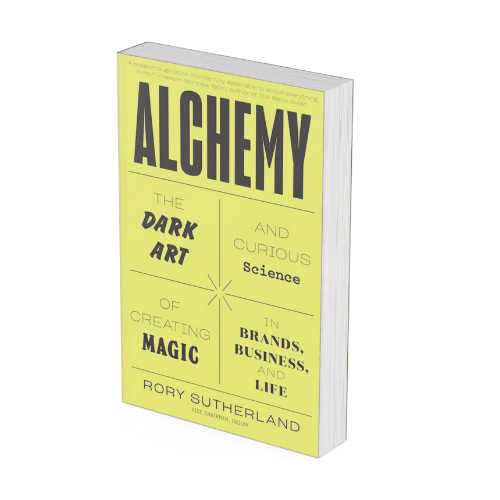
Alchemy: The Dark Art and Curious Science of Creating Magic in Brands, Business, and Life
by Rory Sutherland
Rory Sutherland is a prominent British advertising executive and Vice Chairman of Ogilvy UK. Known for his wit, creativity, and unconventional approach, Sutherland has become a leading figure in the advertising industry. His work is rooted in behavioural economics, where he explores the irrational side of human behaviour and how it can be harnessed to create value in marketing and business. Sutherland’s insights have earned him a reputation as a thought leader who challenges conventional wisdom and encourages enterprises to think differently about consumer behaviour, branding, and value creation. His work often blurs the lines between art and science, making his contributions unique and impactful.
Sutherland points out that a lot of human behaviour is just the result of something that can’t be ruled out by classical logic, and so the smartest ways to do things are the ones that don’t make sense on paper.
The book is broken down into a few chapters and covers different areas of business, marketing, and human behaviour within which unconventional thinking can prove to be quite effective. Sutherland explores “psychological moonshots”, the little, seemingly minor shifts that can create disproportionate value. He takes issue with the overdependence on data and analytics on the part of human society, claiming that those two tools, though useful, tend to miss the nuances of human psychology.
One of the main messages of the book is perception is reality. Sutherland is adamant that how something looks can matter more than what is in it, in marketing and branding in particular. He shows how creative, non-linear thinking can solve problems that are beyond the capacity for solution that classical thinking, through examples ranging from the media to the business strategies and advertising campaigns.
Sutherland also discusses the limitation of rational decision-making. He maintains that only through understanding and using the irrational, which is how an author thinks humans behave, businesses can create new pathways to their expansion and creativity are they to work in accordance with an open mind. Whether taking a page on the power of placebo effects, framing and “Alchemy,” whether it’s the manipulation of framing and their effects, this story invites readers to see things that would not be found from the plainer world, to go beyond the simple and embrace the unexpected, and then to get back.
Reading “Alchemy” was hard, but it was an eye-opener for me at the same time. Rory Sutherland, who uses real-world examples and then combines them into something totally new and very practical, has a gift for weaving behavioural economics. The balance between research and practical application has both depth and depth to it. His thesis that human behaviour frequently eludes rational explanation speaks to my work and personal life.
One of the most profound lessons of the book is the power of tiny, irrational alterations. Small changes to perspective or behaviour may lead to dramatic client discoveries in practice. Sutherland’s concept of “psychological moonshots” goes along with this point. And sometimes the subtlest changes are the most impactful. Sutherland’s critique of overreliance on data particularly piqued my interest. In a time of analytics making decisions increasingly informed, the human factor is easy to lose sight of.
Sutherland’s call to counterbalance data with creativity and intuition is a timely reminder that not everything valuable is quantifiable. I have also found this to be the case in therapy. Numbers and metrics can tell us who we are. Yet the real breakthroughs often come from understanding humanity entirely. The chapter’s discussion of perception and reality was close to heart. It was how we talk about our experiences that touched each of our hearts. This is an idea that I regularly work with in the session to help clients change the way they think, and have the skills to make a positive change.
Sutherland’s experiences from the realm of branding and marketing shows how potent this is, when played out thoughtfully.
I Promote the Sharing of the teachings from “Alchemy: The Dark Art and Curious Science of Creating Magic in Brands, Business, and Life”.
Adopt Creativity and Intuition: Be open to thinking outside the box and trust your gut, even when the logic doesn’t.
The Little Changes Always Made The Big Improvements: Don’t ignore that a little changes can make a huge difference in your work.
What You Say Matters: Focus on how you frame a situation; how you perceive and present things can determine the outcome more than the facts.
Balance Data with Human Insight: Use data as a tool, but don’t let it blind you to the power of human input, experience, intuition, and imagination.
Question Conventional Wisdom: Be prepared to interrogate all the conventional wisdom, be willing to challenge it, and be open to challenging even the best of it, especially when it’s not something that suits you.
In Summary.
Alchemy: The Dark Art and Curious Science of Creating Magic in Brands, Business, and Life by Rory Sutherland is a thought-provoking exploration of how embracing irrationality, creativity, and intuition can lead to extraordinary results. It seeks to confront all kinds of ideas and encourages decision-making that is more integrated by combining information with human judgment. This book was recommended for everyone wanting to break free from the traditional ways of thinking and explore new horizons whether in business or in life itself.
Alchemy: The Dark Art and Curious Science of Creating Magic in Brands, Business, and Life
by Rory Sutherland
Rory Sutherland is a prominent British advertising executive and Vice Chairman of Ogilvy UK. Known for his wit, creativity, and unconventional approach, Sutherland has become a leading figure in the advertising industry. His work is rooted in behavioural economics, where he explores the irrational side of human behaviour and how it can be harnessed to create value in marketing and business. Sutherland’s insights have earned him a reputation as a thought leader who challenges conventional wisdom and encourages enterprises to think differently about consumer behaviour, branding, and value creation. His work often blurs the lines between art and science, making his contributions unique and impactful.
Sutherland points out that a lot of human behaviour is just the result of something that can’t be ruled out by classical logic, and so the smartest ways to do things are the ones that don’t make sense on paper.
The book is broken down into a few chapters and covers different areas of business, marketing, and human behaviour within which unconventional thinking can prove to be quite effective. Sutherland explores “psychological moonshots”, the little, seemingly minor shifts that can create disproportionate value. He takes issue with the overdependence on data and analytics on the part of human society, claiming that those two tools, though useful, tend to miss the nuances of human psychology.
One of the main messages of the book is perception is reality. Sutherland is adamant that how something looks can matter more than what is in it, in marketing and branding in particular. He shows how creative, non-linear thinking can solve problems that are beyond the capacity for solution that classical thinking, through examples ranging from the media to the business strategies and advertising campaigns.
Sutherland also discusses the limitation of rational decision-making. He maintains that only through understanding and using the irrational, which is how an author thinks humans behave, businesses can create new pathways to their expansion and creativity are they to work in accordance with an open mind. Whether taking a page on the power of placebo effects, framing and “Alchemy,” whether it’s the manipulation of framing and their effects, this story invites readers to see things that would not be found from the plainer world, to go beyond the simple and embrace the unexpected, and then to get back.
Reading “Alchemy” was hard, but it was an eye-opener for me at the same time. Rory Sutherland, who uses real-world examples and then combines them into something totally new and very practical, has a gift for weaving behavioural economics. The balance between research and practical application has both depth and depth to it. His thesis that human behaviour frequently eludes rational explanation speaks to my work and personal life.
One of the most profound lessons of the book is the power of tiny, irrational alterations. Small changes to perspective or behaviour may lead to dramatic client discoveries in practice. Sutherland’s concept of “psychological moonshots” goes along with this point. And sometimes the subtlest changes are the most impactful. Sutherland’s critique of overreliance on data particularly piqued my interest. In a time of analytics making decisions increasingly informed, the human factor is easy to lose sight of.
Sutherland’s call to counterbalance data with creativity and intuition is a timely reminder that not everything valuable is quantifiable. I have also found this to be the case in therapy. Numbers and metrics can tell us who we are. Yet the real breakthroughs often come from understanding humanity entirely. The chapter’s discussion of perception and reality was close to heart. It was how we talk about our experiences that touched each of our hearts. This is an idea that I regularly work with in the session to help clients change the way they think, and have the skills to make a positive change.
Sutherland’s experiences from the realm of branding and marketing shows how potent this is, when played out thoughtfully.
I Promote the Sharing of the teachings from “Alchemy: The Dark Art and Curious Science of Creating Magic in Brands, Business, and Life”.
Adopt Creativity and Intuition: Be open to thinking outside the box and trust your gut, even when the logic doesn’t.
The Little Changes Always Made The Big Improvements: Don’t ignore that a little changes can make a huge difference in your work.
What You Say Matters: Focus on how you frame a situation; how you perceive and present things can determine the outcome more than the facts.
Balance Data with Human Insight: Use data as a tool, but don’t let it blind you to the power of human input, experience, intuition, and imagination.
Question Conventional Wisdom: Be prepared to interrogate all the conventional wisdom, be willing to challenge it, and be open to challenging even the best of it, especially when it’s not something that suits you.
In Summary.
Alchemy: The Dark Art and Curious Science of Creating Magic in Brands, Business, and Life by Rory Sutherland is a thought-provoking exploration of how embracing irrationality, creativity, and intuition can lead to extraordinary results. It seeks to confront all kinds of ideas and encourages decision-making that is more integrated by combining information with human judgment. This book was recommended for everyone wanting to break free from the traditional ways of thinking and explore new horizons whether in business or in life itself.
“The only way to make sense out of change is to plunge into it, move with it, and join the dance“
Recent Thoughts
Performance Lab Environment for Mental Clarity and Focus
High performers are seldom incompetent. They struggle with carryover. Carryover of stress. Carryover of emotion. Carryover of intensity from one room to another.

High Performance Without Burnout
When work is in the high performers’ way, it is very addictive. They are quick, decisive, disciplined, competitive and outcome-oriented. They raise standards.