
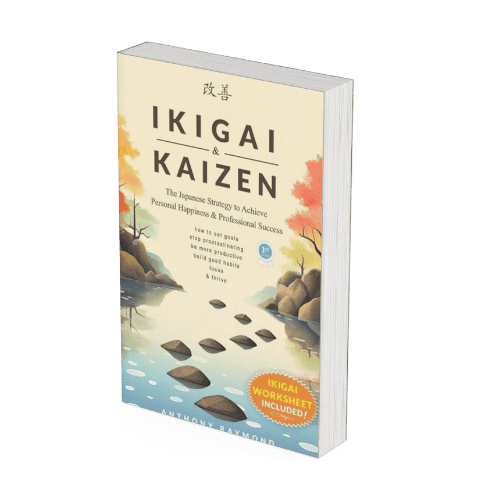
Ikigai & Kaizen: The Japanese Strategy to Achieve Personal Happiness and Professional Success by Anthony Raymond
The Author. Anthony Raymond is a writer and productivity coach who combines Eastern philosophy with Western pragmatism. He doesn’t focus on superficial motivation or quick fixes; his goal is to write for people interested in building lasting habits and discovering what truly matters in their lives. Raymond also uses the Japanese concepts of Ikigai and Kaizen to show how small things lead to significant changes in behavior over time and that consistent actions add up to long-term satisfaction and success. He writes clearly and in an approachable style. He adds structure and perspective without the rigidity of academic or overly sophisticated writing. You can tell he did his own work—just sharing what has helped him and others live and work more purposefully.
Summary of “Ikigai & Kaizen: The Japanese Strategy to Achieve Personal Happiness and Professional Success”
This book combines two core Japanese philosophies, Ikigai and Kaizen, and shows us how they can work together for a more satisfying, holistic life. Ikigai loosely translates to ‘reason for being’. It is this feeling of meaning that motivates you to wake up every morning. It’s when all these things intersect: what you love, what you’re good at, what the world needs, and what you can get paid for. Raymond states that finding your ikigai isn’t about pursuing one major passion, it’s about noticing what is satisfying and shaping your daily actions with that meaning. Kaizen means “change for the better” or “continuous improvement”. It’s the idea that big victories can only come from small, ongoing actions. Instead of striving for perfection or huge leaps, you make small daily improvements, 1% better every single day. Raymond explains that your ikigai lives on because Kaizen is the core principle. The book traces how these two principles complement each other. Ikigai provides you with direction, your “why.” Kaizen provides the process, your “how.” And when you pair them, the lifestyle is realistic, long-lasting, and focused on growth. Raymond also looks at practical implications for things like a career, a relationship, health, self-development. He uses examples from Japanese culture and business, providing a relatable framework for modern readers. This is not about becoming someone new, he explains; this is about going back to what already feels meaningful and gradually building upon it. He divides exercises into steps to help you find your ikigai (such as journaling prompts and reflection questions) and frameworks to apply Kaizen (like habit stacking and measuring small wins). You see how happiness and success aren’t separate goals, because they are not separate, but linked through purpose and progress in the end.
My Thoughts on “Ikigai & Kaizen”
This is a book where philosophy meets the real world. Many self-help books go too far in one direction, and as a result, they remain either abstract or become cold checklists. Raymond is somewhere in a good middle ground. He honors the depth of Japanese philosophy even as he makes it authentically useful in daily life. The thing I liked best was his connection of purpose and process. I see a lot with clients and individuals like ourselves: People who no longer care about what gives their lives meaning or those overwhelmed (by instant results) feel trapped. This book translates both languages and gives them structure. While Ikigai helps you reconnect with your reason, Kaizen teaches you to slow down, build step by step, slowly, and focus on building a plan. And it grounds, so it touches deeply. This is a society that begs, “go big or go home.” This book teaches you that tiny, steady successes are the path to greater peace and sustainability. I also liked that Raymond doesn’t romanticize Japanese culture, which has been his first great advantage in this role. He doesn’t treat these concepts as trendy buzzwords. He explains them in a kind and thoughtful manner. And uses these words for the sake of people’s own experience. In my practice, this realization shows me how powerful it is that people engage meaning in their lives every day. The more you know why you’re doing something, the easier the “how.” And stop trying to reinvent your entire life all at once and change is a deal everyone can understand. This book teaches exactly that. I also liked the doable nature of the exercises. They do not require hours of journaling, or some sort of rigid system. They redirect you toward clarity and momentum. For instance, in early learning, ask yourself what activities make time feel as though it disappears — this simple and powerful tactic lays the foundation for discovering your ikigai. This isn’t a loud book. It’s steady, balanced, and practical. It’s the sort of book you store on your shelf and turn to back when you appear lost or burnt out.
I will invite clients and co-workers to follow the principles of “Ikigai & Kaizen”. Discover how clients use their ikigai to help themselves: what they love, what they are good at, what the world needs, and what they can be paid for. Apply Kaizen to accomplish goals in smaller, sustainable increments, not big jumps. Suggest reflection, purpose isn’t something you discover overnight. It’s uncovered through self-awareness. Encourage clients to celebrate micro-wins. But small wins build confidence and keep motivation. Start daily gratitude, mindfulness exercises, and activities. Help clients also apply Kaizen to emotional growth, rather than work or habits. Think incremental improvement, of course. Then, with professionals, apply the Kaizen mindset to prevent burnout. Instead, it is progress before perfection that is the path to longevity. Discuss in session how what clients are doing at the moment relates (or doesn’t) with their ikigai. Adjust habits accordingly. Help guide clients away from quick-fix thinking and into a rhythm, a consistency, and a long way from growth. Use both as a balance framework: purpose for direction, improvement for momentum.
Finally, in conclusion, Ikigai & Kaizen is a thoughtful practical guide to seeking meaning as well as creating stable progress in business and everyday life. Anthony Raymond blends Japanese wisdom and real-life application, emphasizing that happiness is not a destination. It is something we pick up on each day as simply some small habits we actively practice. This book is a quiet, grounded method of life with purpose and peace.
Ikigai & Kaizen: The Japanese Strategy to Achieve Personal Happiness and Professional Success by Anthony Raymond
The Author. Anthony Raymond is a writer and productivity coach who combines Eastern philosophy with Western pragmatism. He doesn’t focus on superficial motivation or quick fixes; his goal is to write for people interested in building lasting habits and discovering what truly matters in their lives. Raymond also uses the Japanese concepts of Ikigai and Kaizen to show how small things lead to significant changes in behavior over time and that consistent actions add up to long-term satisfaction and success. He writes clearly and in an approachable style. He adds structure and perspective without the rigidity of academic or overly sophisticated writing. You can tell he did his own work—just sharing what has helped him and others live and work more purposefully.
Summary of “Ikigai & Kaizen: The Japanese Strategy to Achieve Personal Happiness and Professional Success”
This book combines two core Japanese philosophies, Ikigai and Kaizen, and shows us how they can work together for a more satisfying, holistic life. Ikigai loosely translates to ‘reason for being’. It is this feeling of meaning that motivates you to wake up every morning. It’s when all these things intersect: what you love, what you’re good at, what the world needs, and what you can get paid for. Raymond states that finding your ikigai isn’t about pursuing one major passion, it’s about noticing what is satisfying and shaping your daily actions with that meaning. Kaizen means “change for the better” or “continuous improvement”. It’s the idea that big victories can only come from small, ongoing actions. Instead of striving for perfection or huge leaps, you make small daily improvements, 1% better every single day. Raymond explains that your ikigai lives on because Kaizen is the core principle. The book traces how these two principles complement each other. Ikigai provides you with direction, your “why.” Kaizen provides the process, your “how.” And when you pair them, the lifestyle is realistic, long-lasting, and focused on growth. Raymond also looks at practical implications for things like a career, a relationship, health, self-development. He uses examples from Japanese culture and business, providing a relatable framework for modern readers. This is not about becoming someone new, he explains; this is about going back to what already feels meaningful and gradually building upon it. He divides exercises into steps to help you find your ikigai (such as journaling prompts and reflection questions) and frameworks to apply Kaizen (like habit stacking and measuring small wins). You see how happiness and success aren’t separate goals, because they are not separate, but linked through purpose and progress in the end.
My Thoughts on “Ikigai & Kaizen”
This is a book where philosophy meets the real world. Many self-help books go too far in one direction, and as a result, they remain either abstract or become cold checklists. Raymond is somewhere in a good middle ground. He honors the depth of Japanese philosophy even as he makes it authentically useful in daily life. The thing I liked best was his connection of purpose and process. I see a lot with clients and individuals like ourselves: People who no longer care about what gives their lives meaning or those overwhelmed (by instant results) feel trapped. This book translates both languages and gives them structure. While Ikigai helps you reconnect with your reason, Kaizen teaches you to slow down, build step by step, slowly, and focus on building a plan. And it grounds, so it touches deeply. This is a society that begs, “go big or go home.” This book teaches you that tiny, steady successes are the path to greater peace and sustainability. I also liked that Raymond doesn’t romanticize Japanese culture, which has been his first great advantage in this role. He doesn’t treat these concepts as trendy buzzwords. He explains them in a kind and thoughtful manner. And uses these words for the sake of people’s own experience. In my practice, this realization shows me how powerful it is that people engage meaning in their lives every day. The more you know why you’re doing something, the easier the “how.” And stop trying to reinvent your entire life all at once and change is a deal everyone can understand. This book teaches exactly that. I also liked the doable nature of the exercises. They do not require hours of journaling, or some sort of rigid system. They redirect you toward clarity and momentum. For instance, in early learning, ask yourself what activities make time feel as though it disappears — this simple and powerful tactic lays the foundation for discovering your ikigai. This isn’t a loud book. It’s steady, balanced, and practical. It’s the sort of book you store on your shelf and turn to back when you appear lost or burnt out.
I will invite clients and co-workers to follow the principles of “Ikigai & Kaizen”. Discover how clients use their ikigai to help themselves: what they love, what they are good at, what the world needs, and what they can be paid for. Apply Kaizen to accomplish goals in smaller, sustainable increments, not big jumps. Suggest reflection, purpose isn’t something you discover overnight. It’s uncovered through self-awareness. Encourage clients to celebrate micro-wins. But small wins build confidence and keep motivation. Start daily gratitude, mindfulness exercises, and activities. Help clients also apply Kaizen to emotional growth, rather than work or habits. Think incremental improvement, of course. Then, with professionals, apply the Kaizen mindset to prevent burnout. Instead, it is progress before perfection that is the path to longevity. Discuss in session how what clients are doing at the moment relates (or doesn’t) with their ikigai. Adjust habits accordingly. Help guide clients away from quick-fix thinking and into a rhythm, a consistency, and a long way from growth. Use both as a balance framework: purpose for direction, improvement for momentum.
Finally, in conclusion, Ikigai & Kaizen is a thoughtful practical guide to seeking meaning as well as creating stable progress in business and everyday life. Anthony Raymond blends Japanese wisdom and real-life application, emphasizing that happiness is not a destination. It is something we pick up on each day as simply some small habits we actively practice. This book is a quiet, grounded method of life with purpose and peace.
“A man becomes a man when a man is needed. I’ve seen 40-year-old children cause a man was never needed“
Recent Thoughts

Performance Lab Environment for Mental Clarity and Focus
High performers are seldom incompetent. They struggle with carryover. Carryover of stress. Carryover of emotion. Carryover of intensity from one room to another.

High Performance Without Burnout
When work is in the high performers’ way, it is very addictive. They are quick, decisive, disciplined, competitive and outcome-oriented. They raise standards.