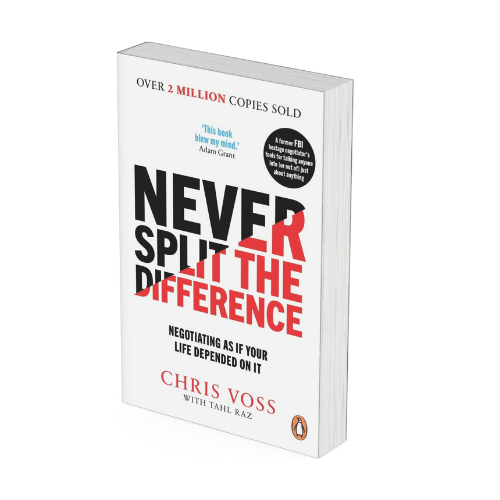
Never Split the Difference
by Chris Voss
Chris Voss spent decades negotiating for the FBI all over the world. He has concentrated on kidnappings, terrorist threats and high-stakes crisis situations. He has affected the way companies communicate. Voss later established The Black Swan Group for executives.
Chris Voss mixes hostage negotiation with business communication methods. These skills are transferable to everyday relationships, as his book demonstrates. He’s against compromise, which he argues almost never brings very real results. It educates its readers psychological/emotional strategies.
And then feelings, also having certain feelings, which makes the negotiation process better. Tools (such as mirroring methods and emotional labelling) are provided by Voss that lead you towards deeper truths as you seek a deeper connection. You should dive deep to find out these unknowns, or “Black Swans.”
Voss describes his tactics with vivid, realistic stories. And in each case, that reveals practical lessons about the ways you learn about different negotiation contexts. Business or romantic, these exercises are channeling untapped potential. Voss believes the keys to success are mindset and empathy. But this book changed my whole perspective on negotiation entirely. Voss challenges the old way of compromise and mutual concessions. His contention is that those allow results to be incomplete. Or emotional awareness is the soil of influence. I love how he talks about how he’s all about empathy and connection. We do business with humans, not dumb machines or data. Voss says: listen carefully, mirror sensitively and gently, name emotions. These trust-building methods help move things along.
His stories also illustrate difficult negotiation advice in tangible forms. I was particularly motivated by the idea of taking the theoretical approach of the Black Swan and I really need to start changing everything I thought I know about hidden data. There’s always more going on behind the scenes than we know, or believe. That’s where the breakthroughs come from, always in therapy or business. I am not dealing with criminals or hostageholders, but the tactics manage to work rather well. When it’s about mirroring — and calibrated questions — they take me into my own client sessions and allow us to feel as though we are really building an attachment. These methods also allow people to be seen, heard and actually understood, without any added pressure or anxiety. Voss redefines negotiation as empathetic communication, rather than manipulation, or bullying.
Tactical empathy helps you see with, within or between the other person’s eyes more clearly. Realizing that your fellow human has thoughts, behaviours, and desires that are useful information changes your communication methods. But it also opens the door for a whole range of new emotional engagement practices. Trust can only happen when you feel that somebody actually listens to you and understands you, as if they’re feeling your real feelings (trust is not conditional; trust is not dependent on what you say). By mirroring, they gently prod them to elaborate, to expand, to keep the conversation from escalating. They gently repeat their last few words over and over, keeping the conversation smooth in its smoothness. Labelling as an emotion clarifies a stage of negotiation that is loaded with emotion or heavily charged. Calling their own feelings out reduces defensiveness and creates an opening for open conversation.
Take a cue and let it remain for a while if conversation is fraught or resistance-derived. And when silence becomes painfully uncomfortable, people will tell their truth. This is the place where insights and negotiation leverage most often appear. That is the power of silence, as Voss puts it. We put the Accusation Audit to work, too, and banish the fears! Before they state objections in name, name them clearly. It vanquishes resistance and enables frank discussion. But more than persuasion, transparency opens doors more powerfully than persuasion can itself. In times you are educated how to soothe, how to manage emotions in adversity or how to quell and moderate how to regulate emotions in a difficult period in time. Do not act on impulse. This means you don’t only react, but rather, take advantage. Instead of the opposite of your original purpose – which is react, you stand still even when things go to hell or come good. Rational, tactical decision making is encouraged by emotional stability. Good decisions call for tactics, and while it’s called strategy because their rational nature is preserved, emotional control means decisions should be strategic–Your judgment is rational and strategic in character. This allows you not to have unwanted friction in doing this (and will strengthen your point again without introducing unwanted friction). This is just the kind of addition that makes your point, and doesn’t create extra pressure. —
In Summary.
Voss combines negotiation, psychology and emotional intelligence in surprisingly slick fashion. His advice is also applicable to work and personal (and routine) relationships; we all do this, so this book teaches us more about the art of dealing with it. And it is both practical and thoughtful, also easy to use in day-to-day life. Now is the moment to push for deeper thought and improved communication behavior on each page. Through negotiation, you will find yourself and other people inside yourself and others. Replace pressure with empathy, and guesswork with clarity. So Voss demonstrates that connection yields better results than control. These are tools that can be beneficial to therapists, coaches and others. If you have a clear and strategic and integrity policy, the world will soon accept it.
.
Never Split the Difference
by Chris Voss
Chris Voss spent decades negotiating for the FBI all over the world. He has concentrated on kidnappings, terrorist threats and high-stakes crisis situations. He has affected the way companies communicate. Voss later established The Black Swan Group for executives.
Chris Voss mixes hostage negotiation with business communication methods. These skills are transferable to everyday relationships, as his book demonstrates. He’s against compromise, which he argues almost never brings very real results. It educates its readers psychological/emotional strategies.
And then feelings, also having certain feelings, which makes the negotiation process better. Tools (such as mirroring methods and emotional labelling) are provided by Voss that lead you towards deeper truths as you seek a deeper connection. You should dive deep to find out these unknowns, or “Black Swans.”
Voss describes his tactics with vivid, realistic stories. And in each case, that reveals practical lessons about the ways you learn about different negotiation contexts. Business or romantic, these exercises are channeling untapped potential. Voss believes the keys to success are mindset and empathy. But this book changed my whole perspective on negotiation entirely. Voss challenges the old way of compromise and mutual concessions. His contention is that those allow results to be incomplete. Or emotional awareness is the soil of influence. I love how he talks about how he’s all about empathy and connection. We do business with humans, not dumb machines or data. Voss says: listen carefully, mirror sensitively and gently, name emotions. These trust-building methods help move things along.
His stories also illustrate difficult negotiation advice in tangible forms. I was particularly motivated by the idea of taking the theoretical approach of the Black Swan and I really need to start changing everything I thought I know about hidden data. There’s always more going on behind the scenes than we know, or believe. That’s where the breakthroughs come from, always in therapy or business. I am not dealing with criminals or hostageholders, but the tactics manage to work rather well. When it’s about mirroring — and calibrated questions — they take me into my own client sessions and allow us to feel as though we are really building an attachment. These methods also allow people to be seen, heard and actually understood, without any added pressure or anxiety. Voss redefines negotiation as empathetic communication, rather than manipulation, or bullying.
Tactical empathy helps you see with, within or between the other person’s eyes more clearly. Realizing that your fellow human has thoughts, behaviours, and desires that are useful information changes your communication methods. But it also opens the door for a whole range of new emotional engagement practices. Trust can only happen when you feel that somebody actually listens to you and understands you, as if they’re feeling your real feelings (trust is not conditional; trust is not dependent on what you say). By mirroring, they gently prod them to elaborate, to expand, to keep the conversation from escalating. They gently repeat their last few words over and over, keeping the conversation smooth in its smoothness. Labelling as an emotion clarifies a stage of negotiation that is loaded with emotion or heavily charged. Calling their own feelings out reduces defensiveness and creates an opening for open conversation.
Take a cue and let it remain for a while if conversation is fraught or resistance-derived. And when silence becomes painfully uncomfortable, people will tell their truth. This is the place where insights and negotiation leverage most often appear. That is the power of silence, as Voss puts it. We put the Accusation Audit to work, too, and banish the fears! Before they state objections in name, name them clearly. It vanquishes resistance and enables frank discussion. But more than persuasion, transparency opens doors more powerfully than persuasion can itself. In times you are educated how to soothe, how to manage emotions in adversity or how to quell and moderate how to regulate emotions in a difficult period in time. Do not act on impulse. This means you don’t only react, but rather, take advantage. Instead of the opposite of your original purpose – which is react, you stand still even when things go to hell or come good. Rational, tactical decision making is encouraged by emotional stability. Good decisions call for tactics, and while it’s called strategy because their rational nature is preserved, emotional control means decisions should be strategic–Your judgment is rational and strategic in character. This allows you not to have unwanted friction in doing this (and will strengthen your point again without introducing unwanted friction). This is just the kind of addition that makes your point, and doesn’t create extra pressure. —
In Summary.
Voss combines negotiation, psychology and emotional intelligence in surprisingly slick fashion. His advice is also applicable to work and personal (and routine) relationships; we all do this, so this book teaches us more about the art of dealing with it. And it is both practical and thoughtful, also easy to use in day-to-day life. Now is the moment to push for deeper thought and improved communication behavior on each page. Through negotiation, you will find yourself and other people inside yourself and others. Replace pressure with empathy, and guesswork with clarity. So Voss demonstrates that connection yields better results than control. These are tools that can be beneficial to therapists, coaches and others. If you have a clear and strategic and integrity policy, the world will soon accept it.
“In the middle of difficulty lies opportunity.“
Recent Thoughts

Performance Lab Environment for Mental Clarity and Focus
High performers are seldom incompetent. They struggle with carryover. Carryover of stress. Carryover of emotion. Carryover of intensity from one room to another.

High Performance Without Burnout
When work is in the high performers’ way, it is very addictive. They are quick, decisive, disciplined, competitive and outcome-oriented. They raise standards.