
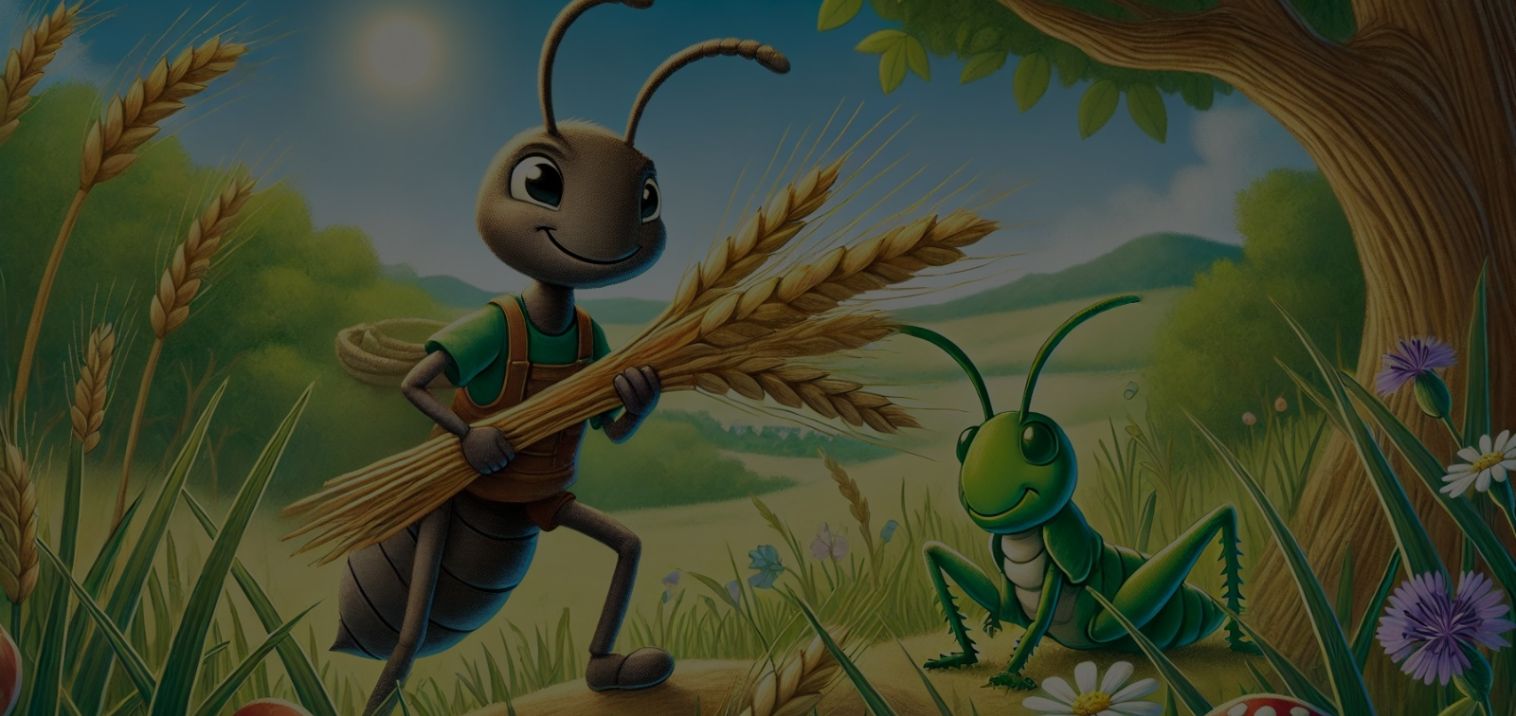
One day on a warm sunny day in a bright meadow, a little, well-behaved ant was working hard, collecting wheat grains for winter storage. She recognized that winter months were coming, and she wanted to be ready. She was busily carrying one grain after another toward her nest when a grasshopper sat nearby observing her with amusement.
Simplicity and playfulness were hallmarks of the day, and the Grasshopper spent his days joyously listening to music and playing. And when he saw the ant do her work he laughed and shouted to her, “Why are you working so hard sweet ant? Not enough food is available at the moment and the winter is a long way away. Come and join me! Let’s appreciate the perfect weather!”
The ant paused, then watched the Grasshopper. In her kindly response she said, “Thank you for your offer, but I can’t stop. I need to prepare enough to eat for the winter. I mean, when the cold months come on there is nothing to eat and I want to make sure I am prepared.” The Grasshopper, in return, just laughed, shook his head. “Why worry about winter now? Right now, life is for living. Come on sing and dance with me!”
Nevertheless, the ant went on to collect crop on crop, making ready her home for the tougher days. Each day she carried as much food back to her nest as she could as the Grasshopper continued to play, eat, and rest without concern. Over time, the summer moved into autumn and the days reduced to shorter, colder days. Aware of this, the ant became all the more industrious, conscious of the swift approach of winter. On the other hand, the Grasshopper didn’t have to worry.
“Tomorrow is always in the offing,” he said. At last, winter came, and the meadow bore the frost and snow. The trees lay lifeless, and the ground frozen. Food was nowhere to be found. In contrast, the ant was warm, comfortable in her nest; all day-only living her for days in the comfort of a little warm nest in the storeroom and having its room filled with her hard-won food that she’d worked like mad just to build. She might even take some rest, knowing that she was well-prepared for the long, cold months. All the while, the Grasshopper was trembling; cold, hungry, alone. There was no food, he regretted that he hadn’t listened to the ant’s advice soon enough.
Desperate and sorry, he knocked on the door of the ant in the hope she would share some food with him. The ant opened her door and gaped at the penniless, starving Grasshopper. She pitied him but said gently, “Grasshopper, all summer long, I worked hard to gather food while you sang and played. If you had even considered the future, you would be warm and well-fed today as well.” From that day, the Grasshopper vowed never to waste his time once more and plan well in advance and always as the ant did.
Lessons:
The story of the Ant and the Grasshopper tells us many lessons about preparation, responsibility for duty and the outcome, responsibility and the benefits of our choices. Of these, the following are some of the most striking:
Preparation needs to be done: The ant’s forethought offers the lesson to prepare carefully is crucial. The ant also urges that we should never fail to put foresight ahead of ourselves. She prepares for leaner days because she knows that the abundant food available now will end with the present. Likewise, this course can be used for building skills, planning a career, or saving for financial matters.
Seasons of life change; therefore, preparedness may result in resilience and stability.
Lift Your Life into the Now: The Grasshopper’s playfulness represents being in the moment yet also the consequences of forgetting the future. So the story encourages taking in the now properly, without the worry of the future. In the end, full of joy in the now because I look forward to the future.
Well done, and when winter comes, the ants’ hard work pays off: Because as soon as winter sets in, the ant’s dedication and perseverance are a comfort and protection. Even if they are not often immediate, the practice of hard work and patience can be rewarding. Small, consistent acts with a regular pace usually have long-lasting effects on finances, health, job opportunities, education and other life and work development.
Taking Responsibility for Decisions: As opposed to acting like humans do, for the Grasshopper: His actions that affect his fate directly with the spring. Taking responsibility is vital, as when we are forced to acknowledge the flaws in our judgment, we will not fail and learn from them, to make the better choices that will be more effective the next time.
Giving up limits: She doesn’t initially offer her resources, but the ant has a friend of the Grasshopper. But she knows that unlimited help may lead to dependence.
This is a wonderful lesson: It’s great to help others, but to set boundaries is so important as well.
Preparing by Falling Short: The Grasshopper is given a cautionary lesson. Cultures of failure may have the gift of a teacher; however, obstacles are the ground and we can see the chance to go on growth in practical life. Accepting failure with a good mind-set helps us get us to forget about how things were.
The Power of Consistency: The daily consistent labour of the ant creates a well-stocked nest. Even modest tasks can help you get so many things done by consistency over time. Consistent hard work commonly leads to higher levels of individual, relational and work success.
In the last analysis, just like the ant, saving often guards against unexpected expenses. Investing some of our time on new skill acquisition gives us a little headway into the future. Lastly, little, non-intrusive measures of care in relationships establish connections over time. The story of an ant and Grasshopper calls for a living spirit, to enjoy today’s experiences — all things together with the future. This way, we can all lead a stable life and happier life by preparing and becoming steady, getting responsibility and consistency.
Share this Blog
Recent Thoughts

Rumours, Noise and Real Growth: Learning to Keep My Eyes on the Road
Matthew is a closeted gay.” “Matthew jumps from woman to woman.” “He’s money-minded.” “I’ve heard he sees women for free if they ‘offer

Ikigai vs. Workaholism: Why I’ve Given Up Perfectionism and Workaholic Tendencies
1) Confronting Challenges. Throughout my career, I've always faced problems head-on. Being straightforward in tough situations is part of who I am. While