
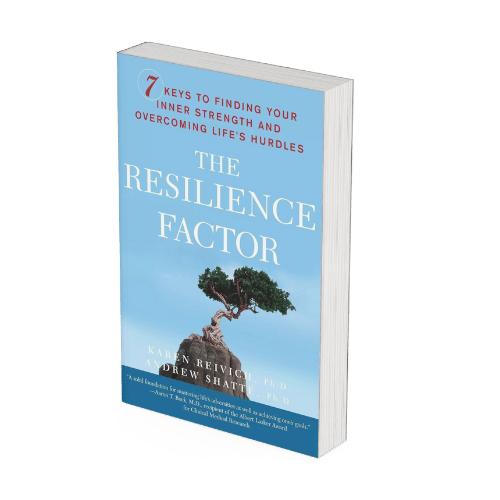
The Resilience Factor
by Andrew Shatte and Karen Reivich
Andrew Shatte, Ph.D., is a leading expert in resilience and a research professor at the University of Arizona. He has devoted his career to understanding how individuals and organisations can build mental toughness and bounce back from adversity. His co-author, Karen Reivich, Ph.D., is a renowned psychologist at the University of Pennsylvania and an expert in positive psychology. Together, they combine decades of research in cognitive-behavioural therapy and resilience to develop practical, science-backed strategies for cultivating resilience in everyday life. Their work draws on the fields of psychology, neuroscience, and behavioural science, offering readers actionable insights grounded in scientific evidence. Andrew Shatte and Karen Reivich’s guide
The Resilience Factor:
7 Keys to Finding Your Inner Strength and Overcoming Life’s Hurdles is a science of resilience that gives readers practical workable advice on how to strengthen their resilience.
The authors draw on decades of research in positive psychology and cognitive-behavioural therapy to establish a conceptual framework for thinking about and creating resilience. The seven major factors that comprise resilience, along with their relationship to the other, inform much of the book. These factors are:
Handling emotions, particularly in adverse circumstances, forms the cornerstone of resilience. It helps the authors give one way of identifying and processing emotional reactions to adversity.
Before acting on any decision, we should stop and think about the possible effect before doing so if pressure is present. The book provides tools to develop greater self-control and avoid doing the things that are bound to compound difficulties. Shatte and Reivich note the significance of staying positive, even in trying circumstances. They examine optimism and resilience and some exercises to support readers in moving toward a more optimistic mindset. Understanding the causes of issues is key to implementing effective solutions.
We learned a lot in our book and got help on spotting, analysing the elements of adversity to help find solutions to those problems. Resilience consists of having insight about others’ feelings and being able to connect with them. They recommend helping you develop your people and have good relationships to support you through tough times. Having faith in power of being able to impact outcomes is an important component of resilience.
The best part is that how to build a sense of self-confidence and will to self-empower when faced with adversity is what the book covers. Finally, the ultimate issue relates to the need for help and support (beyond just asking for it) and broadening your network. From the authors we learn that one must reach out to others in an emotional community to build resilience. Each chapter explores some one of the seven components of resilience and provides real world applications, and practical applications of these principles for cultivating resilience.
The book has a “Resilience Quotient Test” that tells the reader about what level of resilience they’ve attained thus far and points out where they need further development. Shatte and Reivich write in an easy-to-follow scientific style but with accessible insights such as how the Resilience Factor is one of the most effective way help your team to survive life’s toughest situations.
The Resilience Factor reaffirmed how crucial resilience is — the time of crisis and in regular practice. “Shatte and Reivich very well decompose difficult resilience science into a coherent set of easily interpreted action steps that can be easily utilized by my own practice. It uses the basics behind what they are studying for emotional regulation, causal analysis (one-point theory), self-efficacy as well as hope-filled coping strategy and provides practice ways in how clients can be equipped today, in practice, to handle difficulties of the heart or other mental faculties effectively and positively. I also find the book’s focus on strengthening the networks of support to be true to my own view on building resilience. It is a great way to teach therapists for people looking to build more resilience, and it also has so much value for anyone wanting to strengthen their capacity for dealing with life.
Inspired from The Resilience Factor, I encourage client and colleague to learn from it.
Emotional Regulation.
The ability to keep your emotions in check, especially in difficult circumstances, is critical to being resilient. The authors offer strategies for identifying and handling emotional reactions to adversity.
Impulse Control.
Stopping to analyse and to consider consequence is key for making decisions appropriately—and especially under duress—and it is also how you start your training. The book provides a number of strategies so the readers can develop more self-control and resist doing more impulsive things that could make things worse.
Optimism.
Shatte and Reivich emphasize positive mind-set. They delve into how optimism is part of resilience and also provide exercises to prepare our readers to adopt a more optimistic mindset.
Causal Analysis of these examples, they take you from what happens to what people do and how each of us feel about the things we know to help us understand the reasons for such a condition. The book provides methods of identifying and analysing the causes of distress to help the reader to face challenges.
Empathy.
A strong foundation for resilience is learning to interpret and perceive others’ emotions. And it is important in this stage of life to know how to develop empathy and make more solid connections to support you when times get difficult, the authors remind us.
Self-Efficacy.
For resilience, confidence that you can affect results is paramount. The book reviews how to build self-esteem and develop some agency in the face of challenges.
Reaching Out.
The last one concerns asking for assistance and getting broader as a support system.
That’s an advice from the authors, too. The authors say that it is better to reach out to others and build community to help you develop resilience.
In Summary.
The Resilience Factor: Seven Keys to Finding Your Inner Strength and Overcoming Life’s Hurdles by Andrew Shatte and Karen Reivich is an in‑depth and well written guide to building resilience. The framework, grounded in science that is simple to understand and implement, which can help in a plethora of areas of adversity to strengthen mental health will be welcomed by anyone looking for a book to make them stronger and deal with challenges.
The Resilience Factor
by Andrew Shatte and Karen Reivich
Andrew Shatte, Ph.D., is a leading expert in resilience and a research professor at the University of Arizona. He has devoted his career to understanding how individuals and organisations can build mental toughness and bounce back from adversity. His co-author, Karen Reivich, Ph.D., is a renowned psychologist at the University of Pennsylvania and an expert in positive psychology. Together, they combine decades of research in cognitive-behavioural therapy and resilience to develop practical, science-backed strategies for cultivating resilience in everyday life. Their work draws on the fields of psychology, neuroscience, and behavioural science, offering readers actionable insights grounded in scientific evidence. Andrew Shatte and Karen Reivich’s guide
The Resilience Factor:
7 Keys to Finding Your Inner Strength and Overcoming Life’s Hurdles is a science of resilience that gives readers practical workable advice on how to strengthen their resilience.
The authors draw on decades of research in positive psychology and cognitive-behavioural therapy to establish a conceptual framework for thinking about and creating resilience. The seven major factors that comprise resilience, along with their relationship to the other, inform much of the book. These factors are:
Handling emotions, particularly in adverse circumstances, forms the cornerstone of resilience. It helps the authors give one way of identifying and processing emotional reactions to adversity.
Before acting on any decision, we should stop and think about the possible effect before doing so if pressure is present. The book provides tools to develop greater self-control and avoid doing the things that are bound to compound difficulties. Shatte and Reivich note the significance of staying positive, even in trying circumstances. They examine optimism and resilience and some exercises to support readers in moving toward a more optimistic mindset. Understanding the causes of issues is key to implementing effective solutions.
We learned a lot in our book and got help on spotting, analysing the elements of adversity to help find solutions to those problems. Resilience consists of having insight about others’ feelings and being able to connect with them. They recommend helping you develop your people and have good relationships to support you through tough times. Having faith in power of being able to impact outcomes is an important component of resilience.
The best part is that how to build a sense of self-confidence and will to self-empower when faced with adversity is what the book covers. Finally, the ultimate issue relates to the need for help and support (beyond just asking for it) and broadening your network. From the authors we learn that one must reach out to others in an emotional community to build resilience. Each chapter explores some one of the seven components of resilience and provides real world applications, and practical applications of these principles for cultivating resilience.
The book has a “Resilience Quotient Test” that tells the reader about what level of resilience they’ve attained thus far and points out where they need further development. Shatte and Reivich write in an easy-to-follow scientific style but with accessible insights such as how the Resilience Factor is one of the most effective way help your team to survive life’s toughest situations.
The Resilience Factor reaffirmed how crucial resilience is — the time of crisis and in regular practice. “Shatte and Reivich very well decompose difficult resilience science into a coherent set of easily interpreted action steps that can be easily utilized by my own practice. It uses the basics behind what they are studying for emotional regulation, causal analysis (one-point theory), self-efficacy as well as hope-filled coping strategy and provides practice ways in how clients can be equipped today, in practice, to handle difficulties of the heart or other mental faculties effectively and positively. I also find the book’s focus on strengthening the networks of support to be true to my own view on building resilience. It is a great way to teach therapists for people looking to build more resilience, and it also has so much value for anyone wanting to strengthen their capacity for dealing with life.
Inspired from The Resilience Factor, I encourage client and colleague to learn from it.
Emotional Regulation.
The ability to keep your emotions in check, especially in difficult circumstances, is critical to being resilient. The authors offer strategies for identifying and handling emotional reactions to adversity.
Impulse Control.
Stopping to analyse and to consider consequence is key for making decisions appropriately—and especially under duress—and it is also how you start your training. The book provides a number of strategies so the readers can develop more self-control and resist doing more impulsive things that could make things worse.
Optimism.
Shatte and Reivich emphasize positive mind-set. They delve into how optimism is part of resilience and also provide exercises to prepare our readers to adopt a more optimistic mindset.
Causal Analysis of these examples, they take you from what happens to what people do and how each of us feel about the things we know to help us understand the reasons for such a condition. The book provides methods of identifying and analysing the causes of distress to help the reader to face challenges.
Empathy.
A strong foundation for resilience is learning to interpret and perceive others’ emotions. And it is important in this stage of life to know how to develop empathy and make more solid connections to support you when times get difficult, the authors remind us.
Self-Efficacy.
For resilience, confidence that you can affect results is paramount. The book reviews how to build self-esteem and develop some agency in the face of challenges.
Reaching Out.
The last one concerns asking for assistance and getting broader as a support system.
That’s an advice from the authors, too. The authors say that it is better to reach out to others and build community to help you develop resilience.
In Summary.
The Resilience Factor: Seven Keys to Finding Your Inner Strength and Overcoming Life’s Hurdles by Andrew Shatte and Karen Reivich is an in‑depth and well written guide to building resilience. The framework, grounded in science that is simple to understand and implement, which can help in a plethora of areas of adversity to strengthen mental health will be welcomed by anyone looking for a book to make them stronger and deal with challenges.
“The only way to make sense out of change is to plunge into it, move with it, and join the dance.”
Recent Thoughts

Performance Lab Environment for Mental Clarity and Focus
High performers are seldom incompetent. They struggle with carryover. Carryover of stress. Carryover of emotion. Carryover of intensity from one room to another.

High Performance Without Burnout
When work is in the high performers’ way, it is very addictive. They are quick, decisive, disciplined, competitive and outcome-oriented. They raise standards.