
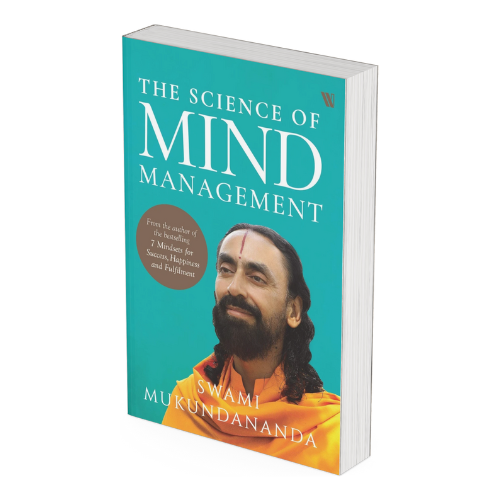
The Science of Mind Management
by Swami Mukundananda.
Swami Mukundananda is a well-known teacher and mindmaster who integrates old Vedic philosophy with new scientific methodology and mind-managing techniques. He graduated from IIT Delhi and IIM Calcutta but eventually gave up a promising career in the corporate world to be a monk under Jagadguru Shree Kripaluji Maharaj. Later Swami Mukundananda founded JKYog advocating yoga, spirituality, and mind control. Over the last 40 years or so, his books, chats and life-transforming talks, which combine wit, pragmatism and profound insights have inspired many millions in developing the modern way of thinking and making the world a better place.
Swami Mukundananda’s book The Science of Mind Management takes a deep dive into how you can use the power of the mind to lead a balanced, happy and meaningful life. The book will be organised by the idea that the most important factor in life quality is what people think or do. In this chapter, Mukundananda covers the four components of the mind: the conscious mind, the subconscious mind, the intellect, and the ego. He describes in particular how each affects our habits and experiences and how we conduct ourselves.
At the start of the book, he starts with a basic understanding and exposition of the mind’s role: as we know, a bit of knowledge, however, but for everyone, it could make or break one’s life. He tells of course the mind as either our best friend or worst enemy, and how well one can handle it really matters to control it or not.
The workings of a subconscious mind are then investigated in some detail by Swami Mukundananda, explaining that a mind builds information stores up information, will shape our mood and the way we perceive things, and determine how we act. If we want to develop a constructive attitude, he focuses on feeding good thoughts into our subconscious.
In addition, this book also covers habit development and the role of willpower. Mukundananda discusses how habits influence our lives and gives ideas to develop self-discipline and overcome bad habits and replace them with the beneficial ones. Also Swami Mukundananda gives practical ideas on how to control one’s mind as well as how to train this with relatable stories, stories from the Vedic literature. Such strategies range from mindfulness to meditation to positive affirmations.
And at this point the book ends with some advice on becoming at peace and fulfilling with the mind. Mukundananda outlines what life requires to be done best with the power of the mind as it has the capacity for personal transformation and spiritual evolution.
Swami Mukundananda’s The Science of Mind Management was genuinely illuminating, exposing you to the inner workings of how the human brain works, as well as valuable strategies of fighting the machine head-on. And one of the main pieces of this book is about the subconscious. Mukundananda details the way it is within our subconscious that the information accumulates and shapes our attitudes.
In addition, as a psychotherapist, I see how certain aspects of the subconscious are reflected in my clients behaviour and emotions. Therefore, this book emphasizes building the subconscious with affirmations and avoiding adverse situations. Moreover, Mukundananda’s theory of habits and willpower is very applicable to where I’m coming from and what I have in mind for treating him. He likens habits to tiny thread wires, reminding us that every task we do every day, even the smallest and smallest, contributes towards forming strong habits. This comparison shows readers that consistent, positive habits over time leads to huge improvement, so the comparison works well.
Moreover, his concepts of addressing bad habits and achieving self-discipline are practical tools I could utilize in my line of work. The skills for practical mind-control on the book is great as well. Mukundananda uses stories of real life instances and mythologies of Vishnu, so that these tactics become easier to understand and attain. For example, mindfulness, meditation and positive affirmations are techniques which as I advise to help improve the mental health. As a holistic strategy for how to use these approaches in your daily life, this book is a systematic guide to become even clearer and more stable in mind and body. I love Swami Mukundananda’s outlook on the attainment of inner peace through mind-control. He stresses that inner calm is an ongoing endeavor that requires hard work and commitment. I think this perspective strongly resonates with my conviction that continuous growth and self-improvement are worthwhile pursuits.
Hence, the book offers a blueprint for how one could draw on the full potential of the mind for their own development. As I can draw from The Science of Mind Management, I encourage clients and staff to:
- Develop Positive Thinking: Keep a wary eye on which thoughts, thoughts, thoughts and beliefs you are having in your mind. Always work on practicing positive affirmations.
- Form Good Habits: It’s also important to concentrate on the little regular activities that build up to good, long-lasting habits. To break bad behaviors through hard work and discipline
- Mindfulness and Meditation: Practicing mindfulness and meditation will help bring you mental clarity as well as give you peace and happiness for the long haul.
- Try to Get Inner Peace: Remember that inner peace is never a destination. Maintain a mindset of self development and self improvement.
- Use a Mind That’s Powerful: Lastly, just realise how much of a big part it is up to your mind to influence your experiences and behavior. Be well versed to your life with mind-management skills.
Conclusion. Therefore, in the end, Swami Mukundananda’s The Science of Mind Management presents powerful insights into the power of the mind in addition to tools to master it. As a career believer in mental health and personal progress, his teachings impacted deeply on the way I pursue betterment of mental health and personal development. The book is therefore an essential to knowledge for anyone in mental wellness and why it matters to read these five books for anyone at any ages of age, wanting to understand psychology because you want to work on your brain and get a better, calmer, more balanced and more fruitful life.
The Science of Mind Management
by Swami Mukundananda.
Swami Mukundananda is a well-known teacher and mindmaster who integrates old Vedic philosophy with new scientific methodology and mind-managing techniques. He graduated from IIT Delhi and IIM Calcutta but eventually gave up a promising career in the corporate world to be a monk under Jagadguru Shree Kripaluji Maharaj. Later Swami Mukundananda founded JKYog advocating yoga, spirituality, and mind control. Over the last 40 years or so, his books, chats and life-transforming talks, which combine wit, pragmatism and profound insights have inspired many millions in developing the modern way of thinking and making the world a better place.
Swami Mukundananda’s book The Science of Mind Management takes a deep dive into how you can use the power of the mind to lead a balanced, happy and meaningful life. The book will be organised by the idea that the most important factor in life quality is what people think or do. In this chapter, Mukundananda covers the four components of the mind: the conscious mind, the subconscious mind, the intellect, and the ego. He describes in particular how each affects our habits and experiences and how we conduct ourselves.
At the start of the book, he starts with a basic understanding and exposition of the mind’s role: as we know, a bit of knowledge, however, but for everyone, it could make or break one’s life. He tells of course the mind as either our best friend or worst enemy, and how well one can handle it really matters to control it or not.
The workings of a subconscious mind are then investigated in some detail by Swami Mukundananda, explaining that a mind builds information stores up information, will shape our mood and the way we perceive things, and determine how we act. If we want to develop a constructive attitude, he focuses on feeding good thoughts into our subconscious.
In addition, this book also covers habit development and the role of willpower. Mukundananda discusses how habits influence our lives and gives ideas to develop self-discipline and overcome bad habits and replace them with the beneficial ones. Also Swami Mukundananda gives practical ideas on how to control one’s mind as well as how to train this with relatable stories, stories from the Vedic literature. Such strategies range from mindfulness to meditation to positive affirmations.
And at this point the book ends with some advice on becoming at peace and fulfilling with the mind. Mukundananda outlines what life requires to be done best with the power of the mind as it has the capacity for personal transformation and spiritual evolution.
Swami Mukundananda’s The Science of Mind Management was genuinely illuminating, exposing you to the inner workings of how the human brain works, as well as valuable strategies of fighting the machine head-on. And one of the main pieces of this book is about the subconscious. Mukundananda details the way it is within our subconscious that the information accumulates and shapes our attitudes.
In addition, as a psychotherapist, I see how certain aspects of the subconscious are reflected in my clients behaviour and emotions. Therefore, this book emphasizes building the subconscious with affirmations and avoiding adverse situations. Moreover, Mukundananda’s theory of habits and willpower is very applicable to where I’m coming from and what I have in mind for treating him. He likens habits to tiny thread wires, reminding us that every task we do every day, even the smallest and smallest, contributes towards forming strong habits. This comparison shows readers that consistent, positive habits over time leads to huge improvement, so the comparison works well.
Moreover, his concepts of addressing bad habits and achieving self-discipline are practical tools I could utilize in my line of work. The skills for practical mind-control on the book is great as well. Mukundananda uses stories of real life instances and mythologies of Vishnu, so that these tactics become easier to understand and attain. For example, mindfulness, meditation and positive affirmations are techniques which as I advise to help improve the mental health. As a holistic strategy for how to use these approaches in your daily life, this book is a systematic guide to become even clearer and more stable in mind and body. I love Swami Mukundananda’s outlook on the attainment of inner peace through mind-control. He stresses that inner calm is an ongoing endeavor that requires hard work and commitment. I think this perspective strongly resonates with my conviction that continuous growth and self-improvement are worthwhile pursuits.
Hence, the book offers a blueprint for how one could draw on the full potential of the mind for their own development. As I can draw from The Science of Mind Management, I encourage clients and staff to:
- Develop Positive Thinking: Keep a wary eye on which thoughts, thoughts, thoughts and beliefs you are having in your mind. Always work on practicing positive affirmations.
- Form Good Habits: It’s also important to concentrate on the little regular activities that build up to good, long-lasting habits. To break bad behaviors through hard work and discipline
- Mindfulness and Meditation: Practicing mindfulness and meditation will help bring you mental clarity as well as give you peace and happiness for the long haul.
- Try to Get Inner Peace: Remember that inner peace is never a destination. Maintain a mindset of self development and self improvement.
- Use a Mind That’s Powerful: Lastly, just realise how much of a big part it is up to your mind to influence your experiences and behavior. Be well versed to your life with mind-management skills.
Conclusion. Therefore, in the end, Swami Mukundananda’s The Science of Mind Management presents powerful insights into the power of the mind in addition to tools to master it. As a career believer in mental health and personal progress, his teachings impacted deeply on the way I pursue betterment of mental health and personal development. The book is therefore an essential to knowledge for anyone in mental wellness and why it matters to read these five books for anyone at any ages of age, wanting to understand psychology because you want to work on your brain and get a better, calmer, more balanced and more fruitful life.
“Leadership is not about being in charge. It is about taking care of those in your charge.”
Recent Thoughts

Performance Lab Environment for Mental Clarity and Focus
High performers are seldom incompetent. They struggle with carryover. Carryover of stress. Carryover of emotion. Carryover of intensity from one room to another.

High Performance Without Burnout
When work is in the high performers’ way, it is very addictive. They are quick, decisive, disciplined, competitive and outcome-oriented. They raise standards.