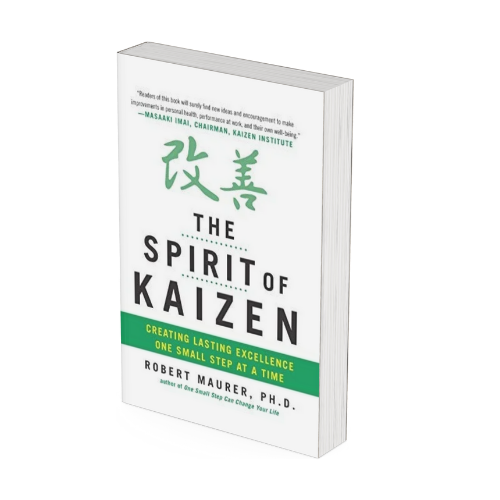
The Spirit of Kaizen: Creating Lasting Excellence, One small step at a time
by Bob Maurer and Leigh Ann Hirschman
Dr. Robert Maurer is a clinical psychologist who applies the Japanese philosophy of Kaizen for lasting change, both in practice at home and at work.
As a consultant for companies like Walt Disney Studios and Costco, Maurer has helped countless institutions and individuals take small, manageable steps towards major change.
Co-author Leigh Ann Hirschman is a passionate writer who breaks down complicated content, writing for people around the world who have found Maurer’s observations helpful. #
The Spirit of Kaizen also introduces the term Kaizen, “continuous improvement,” from Japanese manufacturing, and illustrates how it can change individuals’ behavior at both personal and professional levels.
The authors, Maurer and Hirschman, advise that we change in slow, gradual steps rather than large, revolutionary upheavals. Attention to small, manageable changes enables readers to develop new, sustainable habits, which lower stress levels, soothe anxiety, and support consistent growth.
The book is grounded in the psychology of change. Maurer believes small, concentrated actions help to remove the brain’s obstacles to dramatic changes, and that changes in routines, mindsets, and productivity will naturally follow, but gradually.
The Spirit of Kaizen provides the reader with the ability to apply this principle in every sphere of life, not just toward the realization of better habits, but also in creating more productive workplaces.
The message is clear: To engage in a life of continuous improvement is not to make radical changes or reinvent yourself in new ways, but to make modest, consistent progress every day and every week.
It’s the Spirit of Kaizen that resonates and is based on real psychology, not just hype. It’s not about changing everything on the spot but forming better habits bit by bit, in small, measurable layers. Maurer’s idea of the “small steps” resonates with my work as a coach and therapist.
Most of us, especially those trained to work with people dealing with stress and difficult behavior, have experienced the challenges of real, hard-to-adjust adjustments in managing difficult situations. This book suggests a clearer approach.
As a team leader at Willingness, Kaizen’s suggestions have applied to me personally in my life and in our business operations and culture. The impact has been incredible. Willingness applies this principle of the Kaizen model to everything in our business, from team meetings to client feedback.
Every week, our team gathers to help each other see what worked, where and how to improve, and what we can do to make small progress to help our clients and ourselves. It’s been a weekly cycle of slow improvement, and we’ve seen the impact in terms of happier customers and happier teams.
In our team and quality of care, we see a dramatic difference in how we cooperate and deliver care, with the focus always on achievable and continuous changes, often as opposed to achieving perfection or large-scale change.
Our clients are honest with us all the time that they feel seen and supported because we know what they want – they feel heard, and we act upon it. It keeps our team focused and inspired and ensures we stay motivated as well. Kaizen’s contribution to change also helps build confidence and remove fatigue with a general boost to overall team morale. The Kaizen approach from Maurer and Hirschman has been a breakthrough for us, allowing us to create a culture where continuous improvement becomes the norm for everyone.
I encourage customers and co-workers to try The Spirit of Kaizen.
What do we do from it?
Foster continuous improvement: At Willingness, we’ve seen firsthand how tiny changes can make a big difference. This is true in any context — encourage small and gradual efforts toward progress that stretches far beyond incremental progress.
Encourage Team Engagement and Morale: Make small adjustments that are consistent and manageable, making everyone feel important and less stressed. The purpose of this is to create goodwill, which helps build a healthy corporate culture.
Customer feedback, and also peer feedback, are key to Kaizen; each firm needs to consider these two areas, which Kaizen practices in its entirety. Routine feedback sessions improve service quality and develop robust consumer relations.
Make Small And Attainable Goals: Promote breaking down big goals into smaller bites. These little goals help people stay focused and inspired and reduce their fear of change. Break Through Resistance to Change: Kaizen lowers resistance to change. Stages are the small stuff, and it’s the least resistance the brain has to go through, giving way to gradual transformation.
Acknowledge and celebrate incremental development: This helps to encourage confidence and sustain the resonance of progress, on both a solo and team level.
Promote Consistent Reflection: Regular reflection, for example through weekly feedback sessions, allows a growth mentality that will keep all individuals engaged in the process of self-development.
Keep it in Check: Change need not be radical but is better maintained over time.
Kaizen is very good at this; it is one of its main strengths, and it helps you build long-lasting habits. The essence of Kaizen is to do little things over days, even weeks, so that there will be long-term improvements in effectiveness. By applying these principles at Willingness, satisfaction with the team has improved, as have the nature and degree of collaboration with the client side, showing that meaningful improvements, that are ongoing and intentional, can bring about significant change.
The Spirit of Kaizen: Creating Lasting Excellence, One small step at a time
by Bob Maurer and Leigh Ann Hirschman
Dr. Robert Maurer is a clinical psychologist who applies the Japanese philosophy of Kaizen for lasting change, both in practice at home and at work.
As a consultant for companies like Walt Disney Studios and Costco, Maurer has helped countless institutions and individuals take small, manageable steps towards major change.
Co-author Leigh Ann Hirschman is a passionate writer who breaks down complicated content, writing for people around the world who have found Maurer’s observations helpful. #
The Spirit of Kaizen also introduces the term Kaizen, “continuous improvement,” from Japanese manufacturing, and illustrates how it can change individuals’ behavior at both personal and professional levels.
The authors, Maurer and Hirschman, advise that we change in slow, gradual steps rather than large, revolutionary upheavals. Attention to small, manageable changes enables readers to develop new, sustainable habits, which lower stress levels, soothe anxiety, and support consistent growth.
The book is grounded in the psychology of change. Maurer believes small, concentrated actions help to remove the brain’s obstacles to dramatic changes, and that changes in routines, mindsets, and productivity will naturally follow, but gradually.
The Spirit of Kaizen provides the reader with the ability to apply this principle in every sphere of life, not just toward the realization of better habits, but also in creating more productive workplaces.
The message is clear: To engage in a life of continuous improvement is not to make radical changes or reinvent yourself in new ways, but to make modest, consistent progress every day and every week.
It’s the Spirit of Kaizen that resonates and is based on real psychology, not just hype. It’s not about changing everything on the spot but forming better habits bit by bit, in small, measurable layers. Maurer’s idea of the “small steps” resonates with my work as a coach and therapist.
Most of us, especially those trained to work with people dealing with stress and difficult behavior, have experienced the challenges of real, hard-to-adjust adjustments in managing difficult situations. This book suggests a clearer approach.
As a team leader at Willingness, Kaizen’s suggestions have applied to me personally in my life and in our business operations and culture. The impact has been incredible. Willingness applies this principle of the Kaizen model to everything in our business, from team meetings to client feedback.
Every week, our team gathers to help each other see what worked, where and how to improve, and what we can do to make small progress to help our clients and ourselves. It’s been a weekly cycle of slow improvement, and we’ve seen the impact in terms of happier customers and happier teams.
In our team and quality of care, we see a dramatic difference in how we cooperate and deliver care, with the focus always on achievable and continuous changes, often as opposed to achieving perfection or large-scale change.
Our clients are honest with us all the time that they feel seen and supported because we know what they want – they feel heard, and we act upon it. It keeps our team focused and inspired and ensures we stay motivated as well. Kaizen’s contribution to change also helps build confidence and remove fatigue with a general boost to overall team morale. The Kaizen approach from Maurer and Hirschman has been a breakthrough for us, allowing us to create a culture where continuous improvement becomes the norm for everyone.
I encourage customers and co-workers to try The Spirit of Kaizen.
What do we do from it?
Foster continuous improvement: At Willingness, we’ve seen firsthand how tiny changes can make a big difference. This is true in any context — encourage small and gradual efforts toward progress that stretches far beyond incremental progress.
Encourage Team Engagement and Morale: Make small adjustments that are consistent and manageable, making everyone feel important and less stressed. The purpose of this is to create goodwill, which helps build a healthy corporate culture.
Customer feedback, and also peer feedback, are key to Kaizen; each firm needs to consider these two areas, which Kaizen practices in its entirety. Routine feedback sessions improve service quality and develop robust consumer relations.
Make Small And Attainable Goals: Promote breaking down big goals into smaller bites. These little goals help people stay focused and inspired and reduce their fear of change. Break Through Resistance to Change: Kaizen lowers resistance to change. Stages are the small stuff, and it’s the least resistance the brain has to go through, giving way to gradual transformation.
Acknowledge and celebrate incremental development: This helps to encourage confidence and sustain the resonance of progress, on both a solo and team level.
Promote Consistent Reflection: Regular reflection, for example through weekly feedback sessions, allows a growth mentality that will keep all individuals engaged in the process of self-development.
Keep it in Check: Change need not be radical but is better maintained over time.
Kaizen is very good at this; it is one of its main strengths, and it helps you build long-lasting habits. The essence of Kaizen is to do little things over days, even weeks, so that there will be long-term improvements in effectiveness. By applying these principles at Willingness, satisfaction with the team has improved, as have the nature and degree of collaboration with the client side, showing that meaningful improvements, that are ongoing and intentional, can bring about significant change.
“A man becomes a man when a man is needed. I’ve seen 40-year-old children cause a man was never needed”
Recent Thoughts

Performance Lab Environment for Mental Clarity and Focus
High performers are seldom incompetent. They struggle with carryover. Carryover of stress. Carryover of emotion. Carryover of intensity from one room to another.

High Performance Without Burnout
When work is in the high performers’ way, it is very addictive. They are quick, decisive, disciplined, competitive and outcome-oriented. They raise standards.