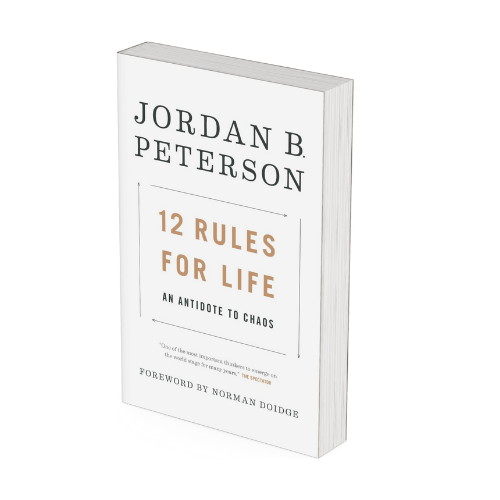
Twelve Rules For Life
by Jordan Peterson
to the introspective, change-minded and intentional lives of the people who try to live their life purposefully.
The book strikes a chord so deeply and makes you think with rich stories and the stories weave in allusions to psychology, literature, and religion. These are Peterson’s means of forging links between timeless wisdom and contemporary coping strategies for the challenges, and conundrums, of life we face. He encourages readers to be tough, because to succeed, you must be tough to suffer. When practiced in this way, people have the ability to search for truth, achieve strength and live more in character and clarity.
I look for deep reading material in books, things that are more difficult, complex or make me look at things and think more deeply. I like books that will stretch my thought and keep me thinking, since they have the power to help me grow, become sharp in my thoughts, and think beyond superficialism. They encourage me out of small space and into profound understanding and overall growth, and provide open doors to more intellectual and emotional growth. 12 Rules for Life is a perfect example of this for me: it’s a mix of psychology, philosophy and a lot advice that falls neatly into the “life and death” categories.
Peterson’s goal was to spark reflection and provoke transformation, not to offer simple solutions or moral absolutes. Whether or not I agree with him, they make me think more critically, honestly, and have more responsibility personally. They cause me to pause, to think, to re-examine with lasting significance where my life is headed. Peterson lists personal responsibility, accountability as the most important principle and one of the more important aspects of daily living. Most people today hold an externalization angle to their situation due to upbringing, society, or bad luck. Peterson defies this narrative and encourages us to confront a situation inside of us and consider how to do better. His honesty is sometimes uncomfortable but also acts as a vehicle for real personal development. When we take responsibility, for anything that we did not do, we own it, we take ownership and we regain our voice.
This idea of linking those standards to larger philosophical and psychological issues was powerful and thought-provoking, I think, and was awesome. The first rule, “Stand up straight with your shoulders back,” sounds like something straightforward. But Peterson links it to human and animal social hierarchies in their inherent existence. He illustrates how our posture affects our sense of self and how others judge our actions. It has deeper significance than the correlation between physical position (to maintain posture) vis-a-vis psychological effect. He encourages readers to realize that little acts could mirror greater interiorities and realities. These concepts are provocative, and they help make abstract theories become real to people’s attention on a daily basis. Peterson calls readers to take up with the truth as they become aware of themselves and change what they do.
I felt that this book actually does not preach but urges thoughtfulness, provokes thoughtfulness and questions widely held beliefs and attitudes and assumptions with complex nuances. Critics of Peterson’s tone have said he feels overly harsh and confrontational (or the views are far too conservative for some readers), but his message is always effective in fostering true intellectual and affective reflection. He makes you question your fundamental beliefs, your values, even your everyday habits, no matter how much you share with him as a whole. In so doing he provides genuine self-reflection that would transform you (not just motivate you to do something superficial or make you feel some shit).
No, Peterson can’t deny the challenges of an honest life, especially when a better life is a life of significance,” he said. No less striking and powerful was the lesson “Tell the truth; or, at least, don’t lie.” In my opinion, many learn to lie or twist the truth to get away from the discomfort, but this behavior actually retards personal development on the worst level, undermining integrity. Peterson makes the point that growth happens when we decide we no longer need to avoid truth and we take the hard part of the situation head-on, no matter how hard or unpleasant. This is the key to being present and authentic: living truthfully becomes simple, however there’s no easy truth and the foundation becomes a foundation for the life of strength.
It is in these challenges that this book ultimately gives readers a mindset that’s resilient enough to handle chaos gracefully and intentionally while taking ownership. What Peterson doesn’t want is just readers following rigid instructions and rules and feeling they should go without thinking about and knowing the situation in which they’re operating. Instead he provides pragmatic principles that are derived from clinical psychology, ancient wisdom and practical experience for personal development. These twelve rules should help us through suffering, disorder and inner strife (what is within the heart.) They prompt us to be stronger, to think more critically, to act more courageously, and to take responsibility for the personal life we construct, day after day.
12 Rules for Life Lessons that Clients and Coworkers Can Follow to Find Truth.
To give more guidance to clients and colleagues, I provided key lessons from Peterson’s book. These insights are of significance in growth of coaching, therapy and all helping professions:
Take charge of your life: Peterson believes individuals must take ownership over their lives.
Short term blaming some people (or things) might get us feel better, but long term if we aren’t going to self decide, and so act individually, it will be almost impossible.
Stand tall and proud and project self-assurance: Teaching client to project their confidence through their body language is important for clients mental well-being. Peterson does not sugarcoat that life is not easy and it’s the hardest to bear, but it is better to accept suffering in its course:
Helping the client to recognise that difficulties are built into a pathway to victory enables clients to develop resilience and experience meaning in adversity.
Self-reflection on a very accurate note and open dialogue are three foundational elements of personal growth: Building better foundations for personal development is enabling customers to address what has happened to them, even if it is difficult.
We hear often about finding happiness in this day and age but Peterson has other suggestions: We should seek significance as opposed to gratification: So we’re more successful long-term and happier.
Balance order and chaos: That’s the best life. And clients can lead more flexible and rewarding lives when they learn to combine structure with flexibility.
Before you even try to do something good in the world, make sure that any issues arise in your own home: Clients need to put their personal wellbeing above all.
Final Thoughts.
12 Rules for Life, by Jordan Peterson:
a difficult book about personal responsibility and the lasting power of your purpose. He implores readers to face suffering head-on rather than run from it. The book’s values help people to become better individuals by truthfully reflecting on and changing their behaviour. Critics may disagree with his views, but Peterson’s arguments make room for reasoned debate. If there is any way to break through this, it would be by reflecting on discipline and purpose, principles that make the best world more palatable to both seekers of truth and personal clarity. Yet ultimately the book provides readers with tools they can live with
more courage, structure, and self-awareness.
Twelve Rules For Life
by Jordan Peterson
to the introspective, change-minded and intentional lives of the people who try to live their life purposefully.
The book strikes a chord so deeply and makes you think with rich stories and the stories weave in allusions to psychology, literature, and religion. These are Peterson’s means of forging links between timeless wisdom and contemporary coping strategies for the challenges, and conundrums, of life we face. He encourages readers to be tough, because to succeed, you must be tough to suffer. When practiced in this way, people have the ability to search for truth, achieve strength and live more in character and clarity.
I look for deep reading material in books, things that are more difficult, complex or make me look at things and think more deeply. I like books that will stretch my thought and keep me thinking, since they have the power to help me grow, become sharp in my thoughts, and think beyond superficialism. They encourage me out of small space and into profound understanding and overall growth, and provide open doors to more intellectual and emotional growth. 12 Rules for Life is a perfect example of this for me: it’s a mix of psychology, philosophy and a lot advice that falls neatly into the “life and death” categories.
Peterson’s goal was to spark reflection and provoke transformation, not to offer simple solutions or moral absolutes. Whether or not I agree with him, they make me think more critically, honestly, and have more responsibility personally. They cause me to pause, to think, to re-examine with lasting significance where my life is headed. Peterson lists personal responsibility, accountability as the most important principle and one of the more important aspects of daily living. Most people today hold an externalization angle to their situation due to upbringing, society, or bad luck. Peterson defies this narrative and encourages us to confront a situation inside of us and consider how to do better. His honesty is sometimes uncomfortable but also acts as a vehicle for real personal development. When we take responsibility, for anything that we did not do, we own it, we take ownership and we regain our voice.
This idea of linking those standards to larger philosophical and psychological issues was powerful and thought-provoking, I think, and was awesome. The first rule, “Stand up straight with your shoulders back,” sounds like something straightforward. But Peterson links it to human and animal social hierarchies in their inherent existence. He illustrates how our posture affects our sense of self and how others judge our actions. It has deeper significance than the correlation between physical position (to maintain posture) vis-a-vis psychological effect. He encourages readers to realize that little acts could mirror greater interiorities and realities. These concepts are provocative, and they help make abstract theories become real to people’s attention on a daily basis. Peterson calls readers to take up with the truth as they become aware of themselves and change what they do.
I felt that this book actually does not preach but urges thoughtfulness, provokes thoughtfulness and questions widely held beliefs and attitudes and assumptions with complex nuances. Critics of Peterson’s tone have said he feels overly harsh and confrontational (or the views are far too conservative for some readers), but his message is always effective in fostering true intellectual and affective reflection. He makes you question your fundamental beliefs, your values, even your everyday habits, no matter how much you share with him as a whole. In so doing he provides genuine self-reflection that would transform you (not just motivate you to do something superficial or make you feel some shit).
No, Peterson can’t deny the challenges of an honest life, especially when a better life is a life of significance,” he said. No less striking and powerful was the lesson “Tell the truth; or, at least, don’t lie.” In my opinion, many learn to lie or twist the truth to get away from the discomfort, but this behavior actually retards personal development on the worst level, undermining integrity. Peterson makes the point that growth happens when we decide we no longer need to avoid truth and we take the hard part of the situation head-on, no matter how hard or unpleasant. This is the key to being present and authentic: living truthfully becomes simple, however there’s no easy truth and the foundation becomes a foundation for the life of strength.
It is in these challenges that this book ultimately gives readers a mindset that’s resilient enough to handle chaos gracefully and intentionally while taking ownership. What Peterson doesn’t want is just readers following rigid instructions and rules and feeling they should go without thinking about and knowing the situation in which they’re operating. Instead he provides pragmatic principles that are derived from clinical psychology, ancient wisdom and practical experience for personal development. These twelve rules should help us through suffering, disorder and inner strife (what is within the heart.) They prompt us to be stronger, to think more critically, to act more courageously, and to take responsibility for the personal life we construct, day after day.
12 Rules for Life Lessons that Clients and Coworkers Can Follow to Find Truth.
To give more guidance to clients and colleagues, I provided key lessons from Peterson’s book. These insights are of significance in growth of coaching, therapy and all helping professions:
Take charge of your life: Peterson believes individuals must take ownership over their lives.
Short term blaming some people (or things) might get us feel better, but long term if we aren’t going to self decide, and so act individually, it will be almost impossible.
Stand tall and proud and project self-assurance: Teaching client to project their confidence through their body language is important for clients mental well-being. Peterson does not sugarcoat that life is not easy and it’s the hardest to bear, but it is better to accept suffering in its course:
Helping the client to recognise that difficulties are built into a pathway to victory enables clients to develop resilience and experience meaning in adversity.
Self-reflection on a very accurate note and open dialogue are three foundational elements of personal growth: Building better foundations for personal development is enabling customers to address what has happened to them, even if it is difficult.
We hear often about finding happiness in this day and age but Peterson has other suggestions: We should seek significance as opposed to gratification: So we’re more successful long-term and happier.
Balance order and chaos: That’s the best life. And clients can lead more flexible and rewarding lives when they learn to combine structure with flexibility.
Before you even try to do something good in the world, make sure that any issues arise in your own home: Clients need to put their personal wellbeing above all.
Final Thoughts.
12 Rules for Life, by Jordan Peterson:
a difficult book about personal responsibility and the lasting power of your purpose. He implores readers to face suffering head-on rather than run from it. The book’s values help people to become better individuals by truthfully reflecting on and changing their behaviour. Critics may disagree with his views, but Peterson’s arguments make room for reasoned debate. If there is any way to break through this, it would be by reflecting on discipline and purpose, principles that make the best world more palatable to both seekers of truth and personal clarity. Yet ultimately the book provides readers with tools they can live with
more courage, structure, and self-awareness.
“The only way to make sense out of change is to plunge into it, move with it, and join the dance“
Recent Thoughts

Performance Lab Environment for Mental Clarity and Focus
High performers are seldom incompetent. They struggle with carryover. Carryover of stress. Carryover of emotion. Carryover of intensity from one room to another.

High Performance Without Burnout
When work is in the high performers’ way, it is very addictive. They are quick, decisive, disciplined, competitive and outcome-oriented. They raise standards.