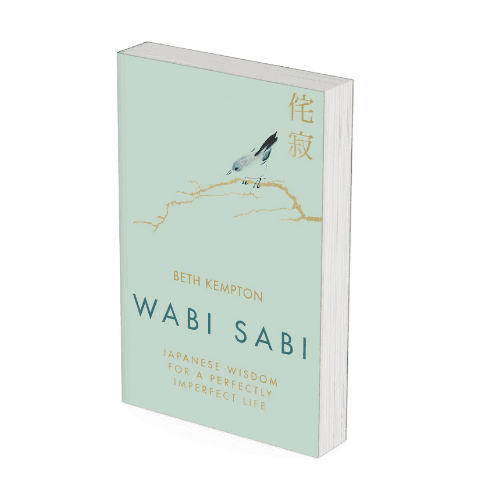
Wabi Sabi by Beth Kempton
The Author
Beth Kempton is a writer, teacher, and entrepreneur who focuses on helping people live more freely, meaningfully, and gently in a chaotic world. She’s not just someone who writes about Japanese culture from the outside, she’s lived it. She speaks fluent Japanese, has spent years immersed in Japanese culture, and brings a respectful, grounded perspective to her teaching. With a background in journalism and business, Beth blends practical thinking with deep introspection. Her style isn’t about chasing perfection or pushing productivity; it’s about letting go, tuning in, and embracing the beauty of things just as they are.
Summary of “Wabi Sabi”
Wabi Sabi: Japanese Wisdom for a Perfectly Imperfect Life invites you to slow down, look more closely, and see beauty in the everyday mess of life. The core of the book revolves around the Japanese concept of “wabi sabi”, a way of seeing the world that values imperfection, impermanence, and incompleteness.
Beth explains that wabi sabi isn’t easy to translate; it’s more of a feeling than a definition. It’s that sense you receive from a weathered old teacup, a quiet moment at the end of the day, or a tree just beginning to lose its leaves. It’s subtle. It’s emotional. And in a world obsessed with control and perfection, it’s deeply needed.
The book is divided into sections that explore how wabi sabi can guide our lives, work, creativity, and relationships. Beth brings in stories, reflections, and small exercises that help us understand how this philosophy can gently shift our thinking. She shares how the Japanese embrace the ageing process, how they design spaces with intentional simplicity, and how they accept that nothing lasts forever.
But the subject isn’t a cultural deep dive or an academic book. It’s personal. Beth writes like someone sharing lessons over a quiet coffee. She doesn’t claim to have it all figured out, she’s learning too, and that humility makes the book feel honest and calming.
Whether she’s talking about clearing clutter, letting go of pressure to succeed, or simply sitting with what is, the message is the same: you are allowed to slow down. You’re allowed to not be perfect. You are simply allowed to be.
My Thoughts on “Wabi Sabi”
This book is soft, but it’s not weak. It’s gentle, but it lands. And to be honest, I think more people need this kind of message, especially in a world that’s constantly shouting at us to do more, achieve more, and be more.
Wabi Sabi isn’t the kind of book that pumps you up with big goals or tells you to hustle harder. It’s the opposite. It encourages you to take a breath, drop the pressure, and find meaning in the moment you’re already in. I respect that. And I think it’s powerful in a different way.
As someone who works with clients navigating anxiety, burnout, grief, identity crises, you name it, I can tell you that so much of our suffering comes from trying to control what we can’t. Alternatively, it stems from resisting the aspects of ourselves that appear excessively chaotic, fractured, or incomplete. This book reminds you that those parts aren’t mistakes, they’re part of the story.
Beth’s writing doesn’t try to impress. It tries to connect. And that’s exactly what she does. She’s honest about her own struggles, and she brings in Japanese culture not as a trend or aesthetic, but as a lived wisdom that has something real to offer.
What I appreciated most was how the book gave me permission to accept imperfections. Sometimes the most useful thing you can do is stop trying to fix, and start trying to notice. Wabi sabi teaches us to notice the beauty in things that are quiet, incomplete, and in progress. That includes ourselves. That includes our relationships.
This isn’t just a book for people who like Japanese design or mindfulness. This is a book for anyone who feels like life is slipping by too fast, or who feels tired of pretending to have it all together.
And yes, there are parts that might feel a bit slow if you’re used to fast, results-driven books. But that’s the whole point. You’re not supposed to rush through this. You’re supposed to sit with it. Let it soak in.
I encourage clients and colleagues to incorporate the teachings from “Wabi Sabi”
Help clients see that imperfection isn’t failure. It’s natural, and often, it’s beautiful.
Use wabi sabi as a framework when clients are stuck in comparison or perfectionism.
Encourage slowing down, especially with clients who are constantly in “fix-it” mode.
Shift the focus from outcome to experience. What matters isn’t always what’s finished, but what’s felt along the way.
Remind clients that growth is not always loud or dramatic. Sometimes it’s quiet and steady.
Introduce rituals and small practices that honour the everyday: tea, journaling, tidying a space without the need to overhaul everything.
Normalize aging, changing, grieving. These are all part of life’s natural rhythm. Wabi sabi gives language and grace to those transitions.
With fellow therapists or coaches, reflect on how we hold space. Are we rushing? Are we trying to fix? Or can we allow the moment to just be?
In team or group settings, wabi sabi can be a way to foster authenticity instead of performance.
Encourage clients to create environments that support peace, not productivity.
In summary
Wabi Sabi is a quiet but strong reminder that life isn’t meant to be perfect. Beth Kempton invites us to look again at the broken, the aging, the unfinished, and see it not as a flaw, but as something deeply human and beautiful. This book is a breath of fresh air in a world that rarely lets us pause.
Wabi Sabi by Beth Kempton
The Author
Beth Kempton is a writer, teacher, and entrepreneur who focuses on helping people live more freely, meaningfully, and gently in a chaotic world. She’s not just someone who writes about Japanese culture from the outside, she’s lived it. She speaks fluent Japanese, has spent years immersed in Japanese culture, and brings a respectful, grounded perspective to her teaching. With a background in journalism and business, Beth blends practical thinking with deep introspection. Her style isn’t about chasing perfection or pushing productivity; it’s about letting go, tuning in, and embracing the beauty of things just as they are.
Summary of “Wabi Sabi”
Wabi Sabi: Japanese Wisdom for a Perfectly Imperfect Life invites you to slow down, look more closely, and see beauty in the everyday mess of life. The core of the book revolves around the Japanese concept of “wabi sabi”, a way of seeing the world that values imperfection, impermanence, and incompleteness.
Beth explains that wabi sabi isn’t easy to translate; it’s more of a feeling than a definition. It’s that sense you receive from a weathered old teacup, a quiet moment at the end of the day, or a tree just beginning to lose its leaves. It’s subtle. It’s emotional. And in a world obsessed with control and perfection, it’s deeply needed.
The book is divided into sections that explore how wabi sabi can guide our lives, work, creativity, and relationships. Beth brings in stories, reflections, and small exercises that help us understand how this philosophy can gently shift our thinking. She shares how the Japanese embrace the ageing process, how they design spaces with intentional simplicity, and how they accept that nothing lasts forever.
But the subject isn’t a cultural deep dive or an academic book. It’s personal. Beth writes like someone sharing lessons over a quiet coffee. She doesn’t claim to have it all figured out, she’s learning too, and that humility makes the book feel honest and calming.
Whether she’s talking about clearing clutter, letting go of pressure to succeed, or simply sitting with what is, the message is the same: you are allowed to slow down. You’re allowed to not be perfect. You are simply allowed to be.
My Thoughts on “Wabi Sabi”
This book is soft, but it’s not weak. It’s gentle, but it lands. And to be honest, I think more people need this kind of message, especially in a world that’s constantly shouting at us to do more, achieve more, and be more.
Wabi Sabi isn’t the kind of book that pumps you up with big goals or tells you to hustle harder. It’s the opposite. It encourages you to take a breath, drop the pressure, and find meaning in the moment you’re already in. I respect that. And I think it’s powerful in a different way.
As someone who works with clients navigating anxiety, burnout, grief, identity crises, you name it, I can tell you that so much of our suffering comes from trying to control what we can’t. Alternatively, it stems from resisting the aspects of ourselves that appear excessively chaotic, fractured, or incomplete. This book reminds you that those parts aren’t mistakes, they’re part of the story.
Beth’s writing doesn’t try to impress. It tries to connect. And that’s exactly what she does. She’s honest about her own struggles, and she brings in Japanese culture not as a trend or aesthetic, but as a lived wisdom that has something real to offer.
What I appreciated most was how the book gave me permission to accept imperfections. Sometimes the most useful thing you can do is stop trying to fix, and start trying to notice. Wabi sabi teaches us to notice the beauty in things that are quiet, incomplete, and in progress. That includes ourselves. That includes our relationships.
This isn’t just a book for people who like Japanese design or mindfulness. This is a book for anyone who feels like life is slipping by too fast, or who feels tired of pretending to have it all together.
And yes, there are parts that might feel a bit slow if you’re used to fast, results-driven books. But that’s the whole point. You’re not supposed to rush through this. You’re supposed to sit with it. Let it soak in.
I encourage clients and colleagues to incorporate the teachings from “Wabi Sabi”
Help clients see that imperfection isn’t failure. It’s natural, and often, it’s beautiful.
Use wabi sabi as a framework when clients are stuck in comparison or perfectionism.
Encourage slowing down, especially with clients who are constantly in “fix-it” mode.
Shift the focus from outcome to experience. What matters isn’t always what’s finished, but what’s felt along the way.
Remind clients that growth is not always loud or dramatic. Sometimes it’s quiet and steady.
Introduce rituals and small practices that honour the everyday: tea, journaling, tidying a space without the need to overhaul everything.
Normalize aging, changing, grieving. These are all part of life’s natural rhythm. Wabi sabi gives language and grace to those transitions.
With fellow therapists or coaches, reflect on how we hold space. Are we rushing? Are we trying to fix? Or can we allow the moment to just be?
In team or group settings, wabi sabi can be a way to foster authenticity instead of performance.
Encourage clients to create environments that support peace, not productivity.
In summary
Wabi Sabi is a quiet but strong reminder that life isn’t meant to be perfect. Beth Kempton invites us to look again at the broken, the aging, the unfinished, and see it not as a flaw, but as something deeply human and beautiful. This book is a breath of fresh air in a world that rarely lets us pause.
“A man becomes a man when a man is needed. I’ve seen 40-year-old children cause a man was never needed”
Recent Thoughts

Performance Lab Environment for Mental Clarity and Focus
High performers are seldom incompetent. They struggle with carryover. Carryover of stress. Carryover of emotion. Carryover of intensity from one room to another.

High Performance Without Burnout
When work is in the high performers’ way, it is very addictive. They are quick, decisive, disciplined, competitive and outcome-oriented. They raise standards.