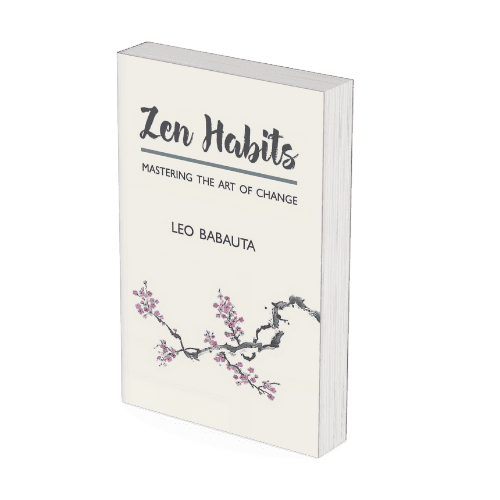
Zen Habits: Handbook for Life by Leo Babauta
The Author.
Leo Babauta is the creator of Zen Habits, a blog that’s been around since the early 2000s and has quietly become one of the most respected voices in the personal development space. He’s not selling hype or hustle, he’s selling simplicity. Leo is a father of six, lives a minimalist lifestyle and writes based on experience rather than theory. His stance is measured, no-nonsense, and refreshingly grounded. He doesn’t pretend to have all the answers. He’s saying instead that as he‘ built better habits, streamlined life and found peace in the dust, it has worked out okay. His writing touches on real change, not overnight change but slow, stable changes which do indeed stick.
Summary of ‘Zen Habits: Handbook for Life’.
This is a book that is Leo Babauta’s work on simplicity, mindfulness and habit formation. And it’s not a book you read in one sitting you reread it, it’s the sort of guide you have to keep coming back to. The advice is lucid, practical and without any fluff. The basic concept is that: Life doesn’t need to be that complicated. Almost all of us are drowning in chores, distraction and mental, physical-and pressure. We are just running in every direction, trying to do everything, and we’re running out of steam. Leo’s straightforward dictum is: slow down. Do less and do more mindfully. He takes the reader over fundamental topics such as:
How to shape habits that last (hint: start small, stay consistent, and forget perfection). So much about decluttering your space and the schedule itself. Let go: letting go of controlling everything. Taking more time in your day-to-day life. Becoming happy with what you have. Acknowledging that everything you’re already doing is okay: what you have. The point is that simplicity is not about trying to have less to avoid it; it’s about making room for the things that matter. Leo doesn’t counsel you to abandon everything or move to a cabin in the wooded area. What he invites you to do is to ask yourself what is genuinely serving you, and what is noise.
The book is heavily reliant on mindfulness as well. You don’t spend hours meditating, but you do have to listen. Whether you’re sipping your coffee, responding back to an email, or chatting with your partner, Leo demonstrates how being totally present makes the situation a lot better. All of that is written in small chapters, and without jargon, urgency or overbearing mood. It is sound wisdom, only the same sound the time and time again.
“Zen Habits: A Philosophy of Life.” This is also exactly the kind of book I really like to recommend. No fluff, no swag, just sound, down-to-earth advice that honors your time and intelligence. Leo Babauta’s writing sounds like it was lived through burnout — and is a result. He’s not interested in shouting at you to change. He’s more like someone standing with you on the trail, offering to help so that you aren’t carried along with him so far.
What I greatly appreciate is the focus on taking small steps. So many people beat themselves up about not following routines, not having willpower, not being “disciplined.” Leo flips that on its head: change does not come from pressure but consistency and compassion. You start small. You say “No” for yourself when you miss a day. And you keep going.
I meet a lot of people in it who are overwhelmed, not because their lives are objectively worse than others, but because they’re trying to do it all, fix everything, control everything. Most of that is unnecessary, and this book is a reminder of that. Life can be simpler. But this won’t just happen. It is choice, simplicity.
One big idea that emerges in the book is how to be okay with uncertainty and imperfection. That’s something I discuss a lot in therapy. People are mostly waiting to feel “ready” so they won’t change anything. But life doesn’t provide us with ideal conditions. Leo wants people to be messy in the beginning, to start from small places and for growth to come automatically.
This book is also helpful as a reminder of how mindfulness isn’t restricted to yoga mats and meditation apps. It’s a way of living. It’s how you brush your teeth, chat with your partner, or walk to work. That down-to-earth, grounded approach to mindfulness is what makes this book so simple to implement.
It’s a quiet book, and that’s precisely its strength. It doesn’t try to impress you. By acknowledging the need for your attention we can assist you return to what matters most (or gets underfoot).
I suggest for everyone using the teachings from “Zen Habits: Handbook for Life”.
– Start small, not big: Make a habit that is small, encourage clients to concentrate on one tiny action instead of trying to change everything at once.
– Give up perfectionism: Progress matters more than being absolutely “right” each time.
– Use mindfulness as a tool, not a fad: When you are present and active, it is easier to learn to keep your focus in everyday routines and reduce stress and improve emotional regulation.
– Reframing productivity: Do less; do it better — it is often more effective than incessant busyness.
– Create self-compassion: Clients don’t have to “fix” themselves. They have to see to it that they keep supporting themselves through transformation.
– Declutter physical and mental space: They think better if their environment is kept simple.
– Teach slow-down: Rushing leads to burnout. Slowing down leads to clarity.
– Assist clients to be OK with uncertainty: Life won’t always make sense. The power of learning to live with that.
– Use habit tracking judiciously: Give off more of a signal of progress than a tick-box.
– Use this principle in sessions: slow things down, listen and be a model of presence as a therapist or coach and do the same in session, slow things down; slow them down with more concentrated listening, practice presence.
In summary. Zen Habits: Handbook for Life is a calm and practical guide to living with less stress and more intention. Leo Babauta doesn’t hold out a magic bullet, he holds out modest adaptations that produce genuine change. If you’re overwhelmed, distracted or stuck, this book will help you bring what is truly important back to yourself. One habit at a time.
Zen Habits: Handbook for Life by Leo Babauta
The Author.
Leo Babauta is the creator of Zen Habits, a blog that’s been around since the early 2000s and has quietly become one of the most respected voices in the personal development space. He’s not selling hype or hustle, he’s selling simplicity. Leo is a father of six, lives a minimalist lifestyle and writes based on experience rather than theory. His stance is measured, no-nonsense, and refreshingly grounded. He doesn’t pretend to have all the answers. He’s saying instead that as he‘ built better habits, streamlined life and found peace in the dust, it has worked out okay. His writing touches on real change, not overnight change but slow, stable changes which do indeed stick.
Summary of ‘Zen Habits: Handbook for Life’.
This is a book that is Leo Babauta’s work on simplicity, mindfulness and habit formation. And it’s not a book you read in one sitting you reread it, it’s the sort of guide you have to keep coming back to. The advice is lucid, practical and without any fluff. The basic concept is that: Life doesn’t need to be that complicated. Almost all of us are drowning in chores, distraction and mental, physical-and pressure. We are just running in every direction, trying to do everything, and we’re running out of steam. Leo’s straightforward dictum is: slow down. Do less and do more mindfully. He takes the reader over fundamental topics such as:
How to shape habits that last (hint: start small, stay consistent, and forget perfection). So much about decluttering your space and the schedule itself. Let go: letting go of controlling everything. Taking more time in your day-to-day life. Becoming happy with what you have. Acknowledging that everything you’re already doing is okay: what you have. The point is that simplicity is not about trying to have less to avoid it; it’s about making room for the things that matter. Leo doesn’t counsel you to abandon everything or move to a cabin in the wooded area. What he invites you to do is to ask yourself what is genuinely serving you, and what is noise.
The book is heavily reliant on mindfulness as well. You don’t spend hours meditating, but you do have to listen. Whether you’re sipping your coffee, responding back to an email, or chatting with your partner, Leo demonstrates how being totally present makes the situation a lot better. All of that is written in small chapters, and without jargon, urgency or overbearing mood. It is sound wisdom, only the same sound the time and time again.
“Zen Habits: A Philosophy of Life.” This is also exactly the kind of book I really like to recommend. No fluff, no swag, just sound, down-to-earth advice that honors your time and intelligence. Leo Babauta’s writing sounds like it was lived through burnout — and is a result. He’s not interested in shouting at you to change. He’s more like someone standing with you on the trail, offering to help so that you aren’t carried along with him so far.
What I greatly appreciate is the focus on taking small steps. So many people beat themselves up about not following routines, not having willpower, not being “disciplined.” Leo flips that on its head: change does not come from pressure but consistency and compassion. You start small. You say “No” for yourself when you miss a day. And you keep going.
I meet a lot of people in it who are overwhelmed, not because their lives are objectively worse than others, but because they’re trying to do it all, fix everything, control everything. Most of that is unnecessary, and this book is a reminder of that. Life can be simpler. But this won’t just happen. It is choice, simplicity.
One big idea that emerges in the book is how to be okay with uncertainty and imperfection. That’s something I discuss a lot in therapy. People are mostly waiting to feel “ready” so they won’t change anything. But life doesn’t provide us with ideal conditions. Leo wants people to be messy in the beginning, to start from small places and for growth to come automatically.
This book is also helpful as a reminder of how mindfulness isn’t restricted to yoga mats and meditation apps. It’s a way of living. It’s how you brush your teeth, chat with your partner, or walk to work. That down-to-earth, grounded approach to mindfulness is what makes this book so simple to implement.
It’s a quiet book, and that’s precisely its strength. It doesn’t try to impress you. By acknowledging the need for your attention we can assist you return to what matters most (or gets underfoot).
I suggest for everyone using the teachings from “Zen Habits: Handbook for Life”.
– Start small, not big: Make a habit that is small, encourage clients to concentrate on one tiny action instead of trying to change everything at once.
– Give up perfectionism: Progress matters more than being absolutely “right” each time.
– Use mindfulness as a tool, not a fad: When you are present and active, it is easier to learn to keep your focus in everyday routines and reduce stress and improve emotional regulation.
– Reframing productivity: Do less; do it better — it is often more effective than incessant busyness.
– Create self-compassion: Clients don’t have to “fix” themselves. They have to see to it that they keep supporting themselves through transformation.
– Declutter physical and mental space: They think better if their environment is kept simple.
– Teach slow-down: Rushing leads to burnout. Slowing down leads to clarity.
– Assist clients to be OK with uncertainty: Life won’t always make sense. The power of learning to live with that.
– Use habit tracking judiciously: Give off more of a signal of progress than a tick-box.
– Use this principle in sessions: slow things down, listen and be a model of presence as a therapist or coach and do the same in session, slow things down; slow them down with more concentrated listening, practice presence.
In summary. Zen Habits: Handbook for Life is a calm and practical guide to living with less stress and more intention. Leo Babauta doesn’t hold out a magic bullet, he holds out modest adaptations that produce genuine change. If you’re overwhelmed, distracted or stuck, this book will help you bring what is truly important back to yourself. One habit at a time.
what actually matters. One habit at a time.
“A man becomes a man when a man is needed. I’ve seen 40-year-old children cause a man was never needed”
Recent Thoughts

Performance Lab Environment for Mental Clarity and Focus
High performers are seldom incompetent. They struggle with carryover. Carryover of stress. Carryover of emotion. Carryover of intensity from one room to another.

High Performance Without Burnout
When work is in the high performers’ way, it is very addictive. They are quick, decisive, disciplined, competitive and outcome-oriented. They raise standards.